Crisis in Korea: America, China, and the Risk of War
Tim Beal
Current developments
Current developments of relevance to the book, with links to the article from which they come.
Inclusion of a article does not mean that I endorse it, either in part or in whole, merely that I consider it relevant. I also try to capture viewpoints from across the spectrum. Because of the age of the book these pages are only updated intermittently.
For a brief 2012 article on some of these quotations see Contrasting perspectives
2017
January
-
Chinese newspaper says Korean peninsula most likely location of armed clash in 2017
Major Chinese news outlets named the Korean Peninsula on Jan. 3 as the most likely region for an armed clash to occur in 2017.
In an editorial titled “Will The World Be More Chaotic in 2017?” the Global Times wrote, “From the perspective of war or new military clashes, the West Pacific is the most dangerous zone.”
“The Korean Peninsula is the primary target,” it continued, adding that the possibility of US President-elect Donald Trump taking an extreme hard line on Pyongyang could not be ruled out.
The editorial went on to say that while the US and China’s broad and complicated relationship has been bound by policy in the past, a more chaotic situation where anything could happen in the West Pacific region if Trump chooses to ignore those restraints.
Kim, Oi-hyun. "Chinese newspaper says Korean peninsula most likely location of armed clash in 2017." Hankyoreh, 4 January 2017.http://english.hani.co.kr/arti/english_edition/e_international/777339.html
-
Will the world be more chaotic in 2017?
The biggest uncertainty in international politics lies in whether Trump will adopt a path poles apart from that of outgoing President Barack Obama. The US is the sole superpower in the world which claims to fill the task of maintaining world order. But Trump's victory has only added anxieties to this US mission. Europe, the Asia-Pacific and the Middle East will be the critical places to test Trump's policies…..
In the Asia-Pacific, how Trump defines and manages Sino-US relations is key. This complicated bilateral relationship carries enormous weight which constrains policies adopted by both leaderships. If Trump ignores such restraint, the West Pacific risks running into turbulence…..
From the perspective of war or new military clashes, the West Pacific is the most dangerous zone. The Korean Peninsula is the primary target, and the Taiwan Straits situation is another. The South China Sea seems to remain moderate, and the only cause of a military confrontation in the waters would be China-US rivalry.
"Will the world be more chaotic in 2017? ." Global Times, 2 January 2017.http://www.globaltimes.cn/content/1026829.shtml
2016
March
-
S.Korea, U.S. Start Biggest-Ever Joint Exercises
More than 17,000 American troops from the U.S. Forces Korea and other overseas bases and some 300,000 South Korean soldiers are taking part.
The two allies will practice so-called "decapitation operations" against the North Korean regime and pre-emptive strikes on North Korean nuclear and missile facilities.
A U.S. combat airborne brigade and a Marine mobile brigade will take part using state-of-the-art equipment like the nuclear-powered aircraft carrier USS John C. Stennis, aerial refueling aircraft, and marine patrol aircraft.
The Stennis is a super-size aircraft carrier with a displacement of more than 90,000 tons. It carries some 80 aircraft, including FA-18 E/F Super Hornet fighter jets. Its fleet consists of three to four Aegis destroyers and cruisers and one to two attack nuclear-powered submarines.
"S.Korea, U.S. Start Biggest-Ever Joint Exercises." Chosun Ilbo, 7 March 2016.
-
Largest ever Korea-US military drill kicks off today
Allies to focus on ‘surgical strikes' on NK nuke facilities
South Korea and the United States will begin their largest-ever joint military exercises, Monday, with a focus on the swift deployment of U.S. strategic assets and "surgical strikes" against North Korea's key nuclear, missile, and other military facilities.
The annual spring exercises on the Korean Peninsula will include two parallel drills ? Key Resolve and Foal Eagle ? involving over 300,000 South Korean troops and 15,000 U.S. personnel, according to South Korean military officials, Sunday. They said this is almost double the number of personnel in previous years……
Seoul and Washington have claimed that the previous drills were purely defensive and non-provocative in their nature.
Triggered by North Korea's latest nuclear test and long-range rocket launch, the allies have abruptly included preparations for preemptive strikes against the military state in their war games this year.
The largely computer-simulated Key Resolve will last for a week and be led by the Republic of Korea -U.S. Combined Forces Command (CFC).
It is aimed at countermeasures against a North Korean attack on the South. But this year's program will also include OPLAN 5015, a wartime plan jointly adopted by Seoul and Washington in June 2015 to prepare for preemptive strikes against Pyongyang if necessary and destroy its weapons of mass destruction.
Yi, Whan-woo. "Largest ever Korea-US military drill kicks off today." Korea Times, 7 March 2016.
February
-
South Korea for the first time openly questions North Korea’s UN eligibility
Strong words at UN meetings come as part of campaign of cutting all ties with the North and abandoning peaceful unification efforts
The Park Geun-hye administration is in the midst of an all-out effort to demonize North Korea. The Ministry of Foreign Affairs under Minister Yun Byung-se has been leading the charge with a full-scale campaign to paint North Korea in outright evil terms to other United Nations member countries. It’s a rhetorical campaign that features descriptions of the sovereign state as a “weapons of mass destruction development organization” and questions about its eligibility to be part of the UN at all.
An example of this came at meetings at UN headquarters in New York on Feb. 15 and 16 by South Korean UN Ambassador Oh Joon and Deputy Ambassador Hahn Choong-hee, who both commented that “questions must be raised about whether North Korea is even eligible to be a member state after violating its responsibilities upon entering the UN.” This marks the first time the South Korean government has openly questioned North Korea’s eligibility at an official UN setting since South and North Korea both joined the institution separately on Sept. 17, 1991…..
The biggest problem of all is the way the Park administration - which has just two years left in office - is torching all bridges between South and North and fostering a climate of extreme distrust and enmity that could leave the next administration unable to attempt any new tactics when it takes over. That would put it in dereliction or violation of the Constitutional obligations of the administration (Article 4) and President (Article 66-3) to pursue “peaceful unification.”
Lee, Je-hun. "South Korea for the first time openly questions North Korea’s UN eligibility." Hankyoreh, 20 February 2016
-
Korea-U.S. Drills to Be Biggest in History
The annual Korea-U.S. joint exercises will be the largest ever in terms of both "quality and quantity," Defense Minister Han Min-goo told Saenuri Party officials at the National Assembly on Thursday.
Twice as many U.S. troops and double the equipment as before, or about 15,000 U.S. troops and hardware like a combat aviation brigade, a Marine mobile brigade, an aircraft carrier fleet, a nuclear-powered submarine fleet, and aerial refueling tankers, will be participating in the drills dubbed "Key Resolve/Foal Eagle."
On the Korean side, the troop numbers will be greater by half than usual at 290,000 personnel, including special operations forces, Army corps in the front-line areas, and Army divisions in the rear areas.
The exercises are aimed at ensuring that troop reinforcements from the mainland U.S. are integrated smoothly on the Korean Peninsula in an emergency.
Meanwhile, Han said the location for a U.S. Terminal High Altitude Area Defense battery will be decided once a joint taskforce makes a suggestion and the governments of Korea and the U.S. approve. "It's regrettable that a brawl over its deployment based on speculation has caused conflict and friction in some regions," Han said, coyly alluding to protests from China and the U.S. as well as resistance from Korean politicians.
"Korea-U.S. Drills to Be Biggest in History." Chosun Ilbo, 19 February 2016
-
Korea-US drills shifting to offensive
Joint military drills by South Korea and the United States are becoming more offensive-oriented, shifting the focus toward infiltration and preemptive strikes away from defense against North Korean attacks…..
The allies are planning to apply their new joint wartime operational plan, dubbed Operation Plan (OPLAN) 5015, which reportedly includes a contingency for preemptive strikes against the North's key facilities, during the annual war game Key Resolve and the field training drill Foal Eagle, military sources said.
The annual drills are scheduled to begin on March 7 and will run until April 30……
The naval forces of the two countries are also planning to hold the annual Ssang Yong (double dragon) amphibious landing training for marines and navy personnel early next month on a larger scale than usual.
More than 7,000 American marines and sailors and some 3,000 South Korean soldiers are expected to participate in the drill. Only 1,000 South Korean troops were in the drill last year.
"More U.S. vessels including amphibious assault ships are joining the exercise this year," said a Navy official on the condition of anonymity, Wednesday.
Jun, Ji-hye. "Korea-US drills shifting to offensive." Korea Times, 17 February 2016.
-
US Plans for North Korea Threaten International Security
Gregory Elich
The reason is not difficult to fathom. North Korea is the only one of the four nations that the U.S. has targeted in its operational war plans. The United States and South Korea signed the latest operational plan in June of last year. Dubbed Oplan 5015, it covers limited war scenarios and includes a preemptive strike on the DPRK’s strategic targets and “decapitation raids” to kill North Korean leaders.
The more North Korea’s nuclear weapons program advances, however, the less likely Oplan 5015 can ever be implemented.
Couple Oplan 5015 with the annual military exercises the U.S. conducts with South Korea, and is it any wonder that North Korea feels threatened? In the West, military exercises are sloughed off as a routine matter and North Korean reaction as overly sensitive. Imagine the hysteria, however, that would greet a joint Russian-Cuban military exercise in the Caribbean, practicing the invasion of the United States. Now multiply that perception by the lopsided power imbalance between the DPRK and the United States, and the North Korean reaction appears more rational. North Korea feels threatened because it is threatened.
During the George W. Bush Administration, U.S. officials counselled their North Korean counterparts to take note of the Libyan example. Libya abandoned its nuclear program in exchange for better relations with the United States and North Korea can do it too, went the message. These days, that message looks rather different, and the DPRK points out that it has found the Libyan example instructive, as well as those of Yugoslavia and Iraq. For a small targeted nation like North Korea, a nuclear deterrent is seen as a means of warding off attack. As a North Korean news commentary put it, the nuclear test was not intended to threaten or provoke, but to cope with the “undisguised hostile policy” of the U.S. and avert “the danger of war with the help of the strongest deterrence.” Given Washington’s propensity in recent years for bombing, invading, destabilizing and overthrowing governments, North Korea’s concern does not seem misplaced…………..
It has already been announced that the annual Key Resolve and Foal Eagle military exercises, slated to run from March 7 through April 30, will be the largest ever held. The exercises, rehearsing the invasion of North Korea, will include the USS John C. Stennis aircraft carrier, the USS North Carolina submarine, B-52 and B-2 bombers, and F-22 fighters. The newly minted Oplan 5015 will play an important role in the exercises
Elich, Gregory. "US Plans for North Korea Threaten International Security." Counterpunch, 17 February 2016.
2015
March
-
The Semiotics of Face Slashing in South Korea
K.J. Noh
US Ambassador to South Korea Mark Lippert was slashed in the face by a radical protestor, Kim Ki Jong, opposed to US interference in Korean politics. “North and South Korea must be united” he shouted, before being taken down by security.
Mr. Kim claimed that he attacked Ambassador Lippert to protest the annual US-Korea “Foal Eagle” war games. These annual live fire war games, the largest on the planet, deploy 200,000 troops, entire aircraft carrier groups, rehearse amphibious landings. Their sheet scope and firepower invariably raise tensions between the Koreas, interfering with efforts for dialogue, de-escalation, and reunification.
Despite a security detail of 29 staff, the costumed radical traditionalist, well known to the police, was able to approach the ambassador and cut his face, leaving a long, deep gash requiring 80 stitches, and catapulting garish images of a horrified ambassador staunching his bloody face all over the world.
This act was considered a huge loss of face for Koreans, with many Koreans sending apologies and self-recriminations to the ambassador, others remonstrating, protesting, or performing on the streets. Highlighting the exquisite contradictions of Korea-US relations, a well-wisher brought over dog meat–for its restorative properties–for the injured dog-loving envoy, signaling tone deaf generosity, attentive wishes for healing, and unconscious enmity. Even more to the last point, traditional folk superstition traditionally requires the ingestion of kindred human flesh.
The government claimed it was an assault on Korean-American relations, and has charged the assailant with attempted murder, assault, and possibly violations of the National Security Law. They have also implied that it was a North Korean plot (the perpetrator owned a copy of Kim Jong-Il’s text on film criticism, and had visited North Korea with official permission on 7 occasions for tree-planting). If the ruling party has its way, this incident will also be the pretext for passing a draconian anti-terror law, hounding opposition as pro-North, and in a stunning non sequitur, implementing the controversial THAAD missile defense system that will escalate tensions with China.
Passions run high, gashes run deep on the Korean peninsula, as the friendly, approachable, former-intelligence-officer-turned-ambassador discovered at the breakfast meeting for reunification where he was to be a speaker.
Underneath the Ambassador’s convivial PR campaigns: blogging and tweeting in Korean, native-costumed events, dog walking in public; beneath the seemingly placid and amicable waters of South Korean-American relations, deeper currents and riptides course, sometimes violently, sometimes explosively, exposing the hidden turbulence and violence of unresolved historic trauma and rage……..
Noh, K.J. "The Semiotics of Face Slashing in South Korea." Counterpunch, 11 March 2015.
February
-
The Ultimate Nightmare: Why Invading North Korea Is a Really Bad Idea
Robert E Kelly
Earlier this month, Pascal-Emmanuel Gobry argued for a US invasion of North Korea.
Thankfully, the general response has been quite negative (here, here and here). Invading North Korea is a terrible idea, and it is worth laying out why in some detail. ….
In 1994, the Clinton Administration came close to launching a massive air campaign against the North (well-discussed here). Then in the first term of President George W Bush, regime change was the watchword and North Korea was on the “axis of evil.” If the Iraq invasion had worked out, it appears other states were on the Bush hit list. Neoconservatives (neocons) love to loathe North Korea.
3. North Korea has Nuclear Weapons:
If the first two reasons are a little soft, this one strikes me as a show-stopper. The US has never fought a sustained conflict against a nuclear power.
Indeed, the very reason North Korea built nuclear weapons was to deter US offensive action. It is hardly a leap of logic to think that the North would launch once US ground forces arrived on its territory. Gobry assumes, far too blithely, that the US could find all the missiles and hit them before they launch. That is a helluva gamble, and certainly not one South Korea or Japan, the likely targets, want to make. At the very least, we cannot go over the heads of Seoul and Tokyo if we choose to seriously strike the North.
4. The (North) Korean People's Army Would Probably Fight:
This is a tricky debate, because we have no good opinion data on KPA morale. We guess at readiness based on drills and the ferocious-looking marches through Kim Il-sung Square and so on. But we don't know.
The neocon position in such situations is to again assume the best – that rogue state armies are paper tigers and would collapse quickly. Certainly the Iraqis did in 1991 and 2003. And I would agree that KPA would suffer revolts if pushed into an offensive against the South. But a US invasion would justify all the propaganda Northern soldiers have heard for decades. Overnight they would go from a conscript army used primarily as slave labor on construction projects to defenders of the nation against a long-foretold invasion.
Do we have any sense that the US military would be “greeted as liberators”? That is yet another huge gamble, because if we are wrong, it is a war against a state where almost every able-bodied male has extensive military training. Even in Iraq, the insurgency showed how tenacious third-world nationalism is and how easy it is for such feelings to ignite when faced with armed foreigners, however noble their intentions.
5. The People's Liberation Army Might Fight Too…..
Kelly, Robert E "The Ultimate Nightmare: Why Invading North Korea Is a Really Bad Idea." National Interest, 30 January 2015
-
The case for invading North Korea
Pascal-Emmanuel Gobry
If someone disputes that there is a moral imperative toward regime change in North Korea — I do not want to argue with him; he shows a corrupt mind. The only question remains: is it feasible? I would like to argue that it is.
1. The military aspect
This is obviously the trickiest part. North Korea has nukes, as well as countless artillery positions trained on Seoul and South Korea. Any attempt at regime change in North Korea must destroy their offensive capabilities in one strike.
U.S. forces should be able to destroy all of North Korea's artillery in one strike. After all, if there's one thing that the U.S. military is very good at, it's launching enormous amounts of rockets and bombs with great precision. With satellite, any significant artillery positions are known. Given the U.S.'s overwhelming technological advantage and total dominance of the sky, and the effect of surprise, it should not be impossible to pull off.
The key question, then, is North Korea's nuclear weapons, and this is a question that no one without access to classified information can answer. But the North Korean regime does not possess many warheads. They cannot be stored in many locations. And it stands to reason that the U.S. intelligence community has been hard at work figuring out where they are, and figuring out a plan on how to get to them. If that could be pulled off, it's possible North Korea could fall quickly, with little harm to anyone outside the country.
(By the way, when the regime falls on its own, as it inevitably must, what will happen to its warheads, and how hard will it be to get them into good hands then?)
Those are big "if"s, but military history is full of stunning successes that were once deemed impossible, like the German push through the Ardennes, D-Day, and the Israeli Air Force's total destruction of the Egyptian Air Force in one strike in the Six Day War.
Gobry, Pascal-Emmanuel "The case for invading North Korea." The Week, 7 January 2015
January
-
N. Korea urges South to stop military drills
North Korea called on South Korea Sunday to stop all military exercises, including joint drills with the United States, if it really wants to improve inter-Korean ties.
"If the South is truly determined to improve inter-Korean relations through dialogue and negotiations ... it should stop all kinds of war schemes, including reckless military exercises carried out jointly with foreign forces," Minju Joson, North Korea's cabinet newspaper, said. "War rehearsals and dialogues cannot coexist."
The North Korean newspaper also warned that if Seoul sticks to the joint war rehearsals against the North, inter-Korean relations will get much worse and the South Korean government will have to take all the responsibility for it.
The Sunday warning is the latest in the North's recent desperate efforts to stop rounds of military exercises conducted annually between South Korea and the U.S…………
The communist country has often warned against and lashed out at such joint drills, which it angrily calls a war rehearsal designed to invade the country.
"N. Korea urges South to stop military drills ". Yonhap, 11 January 2015.
-
US rejects Pyongyang's offer to suspend nuclear tests
The United States has rejected North Korea's surprise offer to temporary suspend nuclear tests if Seoul and Washington halt a joint military exercise.
"Our annual joint military exercises with the Republic of Korea (ROK) are transparent, defense-oriented and have been carried out regularly and openly for roughly 40 years," U.S. Department of State spokeswoman Jen Psaki was quoted as saying by Yonhap News Agency in an e-mail interview, Sunday. "The DPRK statement that inappropriately links routine U.S.-ROK exercises to the possibility of a nuclear test by North Korea is an implicit threat."….
North Korea proposed Saturday that both sides put the brakes on what they consider threats against each other as well as to regional security.
According to Pyongyang's state-controlled Korean Central News Agency (KCNA), the offer was made to ease tensions on the peninsula.
It added the Kim Jong-un regime delivered the proposal in a message to the U.S. government "through a relevant channel."
"The message proposed the U.S. to contribute to easing tension on the Korean Peninsula by temporarily suspending joint military exercises in South Korea and its vicinity this year, and said that in this case the DPRK is ready to take such responsive step as temporarily suspending nuclear tests over which the U.S. is concerned," The KNCA said.
The repressive regime has denounced the annual joint military exercise as a rehearsal for invasion of the North.
Yi, Whan-woo. "US rejects Pyongyang's offer to suspend nuclear tests." Korea Times, 11 January 2015.
2014
December
-
No, North Korea Didn’t Hack Sony
All the evidence leads me to believe that the great Sony Pictures hack of 2014 is far more likely to be the work of one disgruntled employee facing a pink slip.
I may be biased, but, as the director of security operations for DEF CON, the world’s largest hacker conference, and the principal security researcher for the world's leading mobile security company, Cloudflare, I think I am worth hearing out……
To cyber security experts, the naivety of this statement [from the FBI about IP addresses] beggars belief. Note to the FBI: Just because a system with a particular IP address was used for cybercrime doesn’t mean that from now on every time you see that IP address you can link it to cybercrime. Plus, while sometimes IPs can be “permanent”, at other times IPs last just a few seconds.
It isn’t the IP address that the FBI should be paying attention to. Rather it’s the server or service that’s behind it…….
It is this piece of evidence—freely available to anyone with an enquiring mind and a modicum of cyber security experience—which I believe that the FBI is so cryptically referring to when they talk about “additional evidence” they can’t reveal without compromising “national security”.
Essentially, we are being left in a position where we are expected to just take agency promises at face value. In the current climate, that is a big ask……
While it’s (just) plausible that a North Korean elite cyber unit could have built up this knowledge over time and then used it to make the malware, Occam’s razor suggests the simpler explanation of a pissed-off insider. Combine that with the details of several layoffs that Sony was planning and you don’t have to stretch the imagination too far to consider that a disgruntled Sony employee might be at the heart of it all.
Rogers, Marc. "No, North Korea Didn’t Hack Sony." Daily Beast, 24 December 2014.
November
-
What was Panetta thinking?
Former U.S. defense secretary's revelations about going nuclear raise disquieting questions
I have long considered North Korea’s frequent charge that the U.S. is contemplating a nuclear strike clunky and unconvincing. The assertion seemed very much over the top, and as we know from the fairy story, crying wolf unnecessarily is not a good strategy….
The arguments against the U.S. using nuclear weapons in Korea are varied and compelling…….
But to use nuclear weapons against North Korea on its own is another matter. It is preposterous and unnecessary, since the U.S. (with South Korea) is so much stronger in conventional terms. It would also be grossly counterproductive militarily and politically. Whether you regard the idea of a North Korean invasion a possibility or a pretext, all U.S. war plans, such as OPLAN 5027, envisage U.S./ROK forces taking Pyongyang and beyond. A preceding nuclear strike would make that militarily hazardous, let alone imposing huge economic costs for the occupying powers. The devastation would not be confined to the North, or to the Korean People’s Army. In the words of Newsweek:
The specter of nuclear mushroom clouds rising over northeast Asia has long been a staple of nightmare scenarios in the event of another war between North and South Korea. It’s a prospect so apocalyptic that American officials have rarely articulated exactly what would trigger their use of weapons that could instantly kill millions and make the entire peninsula uninhabitable for decades.
So that would dispose of not merely the North Koreans but also the South Koreans, along with the considerable number of Americans resident in South Korea at any particular time. Even a conventional strike against nuclear facilities could be disastrous…..
So all in all the idea of using nuclear weapons to resolve a conventional skirmish in Korea was so absurd as to be easily discounted.
Then along came Leon Panetta and the publication of his memoirs, Worthy Fights: A Memoir of Leadership in War and Peace, and the statement:
If North Korea moved across the border, our war plans called for the senior American general on the peninsula to take command of all U.S. and South Korea forces and defend South Korea— including by the use of nuclear weapons, if necessary.
So it appears that the North Koreans were right after all…….
Thirdly, there is the slight possibility that there may be more to this than meets the eye. It is often difficult to be sure that when public figures do ‘stupid s–t’ – to use Barack Obama’s infelicitous and often sanitized phrase ( “s–t” becomes “stuff” ) – it really is because they are stupid (or at least inattentive) or if there is some cunning plot to hand, a coded message that might be invisible to the general public but be picked up by adversaries and allies.
Was Panetta’s revelation a calculated warning to China that it would use nuclear weapons if they intervened in Korea in the event of a U.S. invasion?
Who knows? Probably not. It would be both too clever, and too stupid.
Beal, Tim. "What was Panetta thinking?" NK News, 20 November 2014
October
-
Chinese Army Practices for War on Korean Peninsula
A Chinese military unit in Shenyang that would be deployed to the Korean Peninsula in case a war breaks out, started a large-scale military drill involving 20,000 personnel on Saturday.
According to the Xinhua news agency, the Chinese army explained this was merely a scheduled drill to improve operational capabilities. But there is speculation that it came in preparation for a sudden turn of events on the peninsula.
Saturday was the 64th anniversary of the Chinese intervention in the Korean War.
This exercise brought together a dozen branches of the army including infantry, an armored unit, air defense forces, and chemical, biological and radiological defense units.
The Chinese People's Liberation Army has carried out seven large-scale military exercises this year, and this will be the biggest, according to Xinhua.
"Chinese Army Practices for War on Korean Peninsula." Chosun Ilbo, 27 October 2014.
-
Panetta Sparks Debate Over U.S. Nuclear Strike on North Korea
The specter of nuclear mushroom clouds rising over northeast Asia has long been a staple of nightmare scenarios in the event of another war between North and South Korea. It’s a prospect so apocalyptic that American officials have rarely articulated exactly what would trigger their use of weapons that could instantly kill millions and make the entire peninsula uninhabitable for decades.
In a memoir published last week, however, former CIA chief and Defense Secretary Leon Panetta reopened the prickly issue, recalling a chilling, 2010 briefing in Seoul by General Walter L. “Skip” Sharp, the commander of U.S. forces in South Korea, who told him just such a nightmare could come true should communist forces pour across the DMZ as they did in 1950.
“If North Korea moved across the border, our war plans called for the senior American general on the peninsula to take command of all U.S. and South Korea forces and defend South Korea— including by the use of nuclear weapons, if necessary,” Panetta writes in “Worthy Fights: A Memoir of Leadership in War and Peace.”
“I left our meeting with the powerful sense that war in that region was neither hypothetical nor remote,” Panetta wrote, ‘but ever-present and imminent.”
Reaction to Panetta’s remarks ranged from shrugs to astonishment that he would so breezily raise the prospect of a nuclear apocalypse. Some experts called Panetta’s pronouncement on U.S. policy unrealistic – and even dangerously misleading. “Typical wooden-headedness on the part of a U.S. official,” a former top CIA expert on Korea called Panetta’s recollection. “How in the world do we think South Koreans will react to the news that the U.S. is prepared to use nuclear weapons on the peninsula? It doesn't reassure them, only makes them think having the U.S. bull in their china shop is maybe not such a good idea,” the former official added on condition of anonymity in exchange for discussing such a sensitive issue. “It also doesn't really scare the North Koreans, who think they have been under a nuclear threat for decades – which is why they developed their own nuclear program.”
Walker, Lauren , and Jeff Stein. "Panetta Sparks Debate Over U.S. Nuclear Strike on North Korea." Newsweek, 14 October 2014.
June
-
S. Korean forces to participate in WMD seeking exercises in the US
The US and South Korean militaries will carry out exercises in the US to locate and eliminate nuclear weapons, biological weapons, and other weapons of mass destruction. With allegations being raised that the exercises presuppose a crisis in North Korea, a backlash from the North is expected….
This is the first time that South Korean ground forces have taken part in joint exercises inside the US….
.., South Korea and the US have been practicing the task of eliminating North Korea’s weapons of mass destruction, under the assumption of a drastic contingency situation in the North, during the Key Resolve joint military exercises since 2009. These exercises are based on the belief that there is a growing danger of nuclear development and nuclear proliferation by North Korea.
Park, Byong-su. "S. Korean forces to participate in WMD seeking exercises in the US." Hankyoreh, 6 June 2014
-
Pentagon: instability on Korea may trigger crisis involving China's military
The Pentagon re-emphasized a threat from China's military in case of instability on the Korean Peninsula, updating its assessment of the rising power's defense capability Thursday.
"In the coming years, instability on the Korean Peninsula could produce a regional crisis involving China's military," it said in an annual report to Congress, titled "Military and Security Developments Involving the People's Republic of China 2014."
The 87-page report highlighted potential threats from China's continued investment in its military. …
Yonhap. "Pentagon: instability on Korea may trigger crisis involving China's military." Korea Times, 6 June 2014.
April
-
Korean Peninsula Situation Report (II)
Since the end of February 2014 Washington and Seoul started to exert pressure on Pyongyang, for instance they launched a series of large-scale military exercises (Key Resolve and Foal Eagle) conducted one by one in a row. The allies tried to paint their activities as actions of defensive nature. They even promised to limit the forces participating in the events and abstain from using the main irritants – strategic bombers and nuclear submarines. It all turned to be otherwise. The number of troops taking part in this year’s Ssang Yong (Double Dragon) exercise held March 27 through April 7 was unprecedented at least since 1993. Almost 10,000 U.S. troops joined the South Korean military in the peninsula’s largest joint amphibious landing drill. The scenario envisaged landing forces to march straight to Pyongyang and seize the North Korean capital……
One way or another, the hopes for re-launching the constructive dialogue between the two Koreas have not materialized. They were doomed to failure. Right after staging the two exercises mentioned above, Washington and Seoul launched new training events. It has never happened before. This time the drills were of unprecedented scale involving hundreds of aircraft.
Many observers were under the impression growing into confidence that the United States was provoking North Korea on purpose to make tensions on the peninsula rise further and thus narrow the window of opportunity for the inter-Korean dialogue. ……
Vorontsov, Alexander. "Korean Peninsula Situation Report (II)." Strategic Culture Foundation, 27 April 2014.
-
Prospect for North-South Relations Depends on Park Geun Hye: CPRK Open Questionnaire
Pyongyang, April 23 (KCNA) -- The Committee for the Peaceful Reunification of Korea (CPRK) sent an open questionnaire to Park Geun Hye Wednesday asking her to give responsible answers to the questions as to whether she stands for the improvement of the north-south relations or seeks to escalate confrontation and whether she wants reunification and peace against war.
Recalling that months-long Key Resolve and Foal Eagle war exercises for invading the north are over, but the south Korean authorities' confrontation with their compatriots and moves for a war against the north are going on and their anti-reunification hysteria under the signboard of "unification" is flouting the nation and disturbing the world, the questionnaire goes on:
1. What kind of "unification" does Park mean? Confrontation of the social systems means one side swallowing up the other side and the latter being swallowed up by the former, the showdown which is bound to lead to a war. Does she want this?
Park seems to call for the confrontation of the social systems, mistaking Korea for Germany. This is a day-dream which will never come true. The confrontation of the social systems precisely means a war. Does Park really stand for the war?...........
"Prospect for North-South Relations Depends on Park Geun Hye: CPRK Open Questionnaire." KCNA, 23 April 2014.
-
N. Korea offers condolences over S. Korean ferry victims
North Korea has expressed its condolences over the sinking of a South Korean ferry in a telephone message through its Red Cross Society, the unification ministry said Wednesday…..
"In the message, the North expressed its deep sorrow over the many victims of the disaster," the ministry said.
The North's condolences are the first of their kind since 2003, when a subway fire and typhoon Maemi rocked the country. The South has yet to respond to the North's message, ministry officials said. The South conveyed its condolences over flooding in North Korea in 2006……..
North Korea experts said that the North's move seems to be intended to improve chilly inter-Korean ties……….
Yonhap. "N. Korea offers condolences over S. Korean ferry victims." Korea Times, 24 April 2014.
-
The contradictions of Dresden
Park’s position on joint military drills, denuclearization doom her proposal…..
Kim Ji-suk, an editorial writer for the liberal Hankyoreh, went to the core with an article entitled “The contradictions of Pres. Park’s Dresden Doctrine.” Kim made a number of astute criticisms including the key observation: “The rising tensions on the peninsula caused by the U.S.-ROK joint military exercises and the stalemate in talks to resolve the North Korean nuclear issue are the flipside of jackpot unification.” His use of the word “contradiction” offers a fruitful way of more rigorously analysing the “Dresden Doctrine,” and indeed Park’s North Korea policy in general…..
There are two sorts of contradiction at play here, and they can be conveniently labeled as external and internal.
By external, I mean the contradiction between what is contained in the proposals themselves and the concrete actions of the Park administration. There are a number of examples of this but the dominant one, the one that subsumes all the others, is the continuation and indeed escalation, of the joint US-ROK military exercises (as Kim notes). These have been going on, in various forms, for decades and they always raise tension on the peninsula…..
The other form of contradiction is where elements of these proposals are at variance with discernable reality. The main one, and the one that means that Park’s Trustpolitik will never get anywhere, at least peacefully, is the emphasis on the nuclear issue. More precisely, it is the demand that the North must unilaterally abandon its nuclear weapons programme……..
North Korea has developed nuclear weapons both as a deterrent to an American attack and a bargaining device to force the U.S. to accept peaceful coexistence and drop the policy of “hostility.” Whether U.S.-DPRK negotiations will ever be able to achieve this goal – bargaining hostility for denuclearization – is a moot issue, much discussed. However, the point here it that it is something which can only be negotiated between Washington and Pyongyang; however galling it might be, Seoul is but a bystander. The president of South Korea cannot speak for the president of the United States, and cannot do a deal over nuclear weapons…..
Park Geun-hye’s North Korea policy, her Trustpolitik, is a policy whose inherent contradictions, whether due to guile, confusion, or self-delusion, predict inevitable failure. This is a great disappointment because she is the pivot on which so much hinges and it bodes ill for the people of both Koreas. A genuine, coherent policy for peaceful, consensual, and mutually beneficial unification is desperately needed.
Beal, Tim. "The contradictions of Dresden." NK News, 25 April 2014.
-
US key to DPRK nuclear issue
On Wednesday the President of the Republic of Korea Park Geun-hye asked Chinese President Xi Jinping to persuade the Democratic People’s Republic of Korea not to conduct a fourth nuclear test when US President Barack Obama visits the ROK…….
The United States has been urging China to press the DPRK on one hand while encouraging Japan to provoke China on the other.
But Uncle Sam is really a business man who wants to gain without pain. The US is pouring fuel on the flames, so the DPRK will be angered and pushed into conducting a fourth nuclear test, which will undermine China’s security and drive a wedge between China and the DPRK. Moreover, the US can fully make use of the DPRK’s nuclear threat to strengthen US-Japan-ROK trilateral cooperation, and eventually form a “mini NATO” in Asia to contain China and Russia.
In fact, the ball is in the US’ court. If it truly wants to resolve the DPRK nuclear issue, it has to abandon the schemes to contain Russia and China with the DPRK nuclear card………..
By portraying the DPRK as a military threat, the US and its Asian allies aim to realize their own strategic goals. The Peninsula nuclear issue has become the best excuse for the US to push forward its “pivot to Asia” policy and strengthen its military ties with its Asian allies. …….
Hu, Mingyuan "US key to DPRK nuclear issue." China Daily, 25 April 2014
March
-
S. Korea, US embark on massive landing drill
South Korea and the United States began a large-scale amphibious landing drill on Thursday as part their annual joint exercise to enhance military readiness, military officials said, drawing an angry response from North Korea.
Navy and Marine Corps of the two nations will stage the Ssang Yong (double dragon) exercise on the southeast coast of the Korea Peninsula until April 7 as part of their annual field training exercise Foal Eagle, which runs through April 18.
The U.S. Seventh Fleet joined the South Korean forces south of the southern island of Jeju earlier in the day before moving to the eastern port city of Pohang for a rehearsal ahead of actual training slated for March 31.
This year's Ssang Yong exercise is the biggest joint marine drills between the two nations since those held during annual training Team Spirit, which was held from 1976 until 1993.
"The scale of this year's Ssang Yong is greater than any other in the past, proving the Navy and Marine Corps' ability to conduct the full spectrum of a combined arms, amphibious landing operation in cooperation with our international partners" the Combined Forces Command said.
The 12-day training includes 200 Marines and 1,000 Navy sailors of South Korea and 7,500 U.S. Marines and 2,000 Navy personnel, as well as 22 Osprey tilt-rotor aircraft and CH-53 heavy-lift helicopters.
The 3rd Marine Expeditionary Brigade from Okinawa and the Seventh Fleet's Commander Task Force will participate in the exercise, which will stage amphibious landing drills and air offensive operations.
The Osprey's design combines a helicopter's operational flexibility of vertical takeoff and landing with greater speed, range, and fuel efficiency, and is capable of carrying about 24-32 personnel. Last year, four Ospreys were dispatched to the peninsula to join the amphibious landing drill.
Seoul officials said the largest-ever amphibious drill illustrates the rising strategic importance of the Korean Peninsula in the Asia-Pacific region under the Obama administration's Asia rebalancing policy.
"It seems that the U.S. Marine Corps considers the Korean Peninsula as one of the most important theaters of military operations in the Asia-Pacific region," a senior South Korean Marine Corp official said.
The landing drills drew a strong response from North Korea, which has routinely condemned the joint exercise between Seoul and Washington as a rehearsal for a northward invasion.
On Monday, the North's state-run Rodong Sinmun denounced the Ssang Yong amphibious landing drill and Max Thunder, a bilateral aerial training exercise, as "typical offensive training," accusing Washington of raising tensions.
"S. Korea, US embark on massive landing drill." Korea Times, 27 March 2014.
-
Seoul, Washington set for largest-ever joint Marine exercise involving V-22 Osprey
More than 10,000 Marines from South Korea and the United States will kick off their largest-ever joint amphibious landing training late this month, the Pentagon said Monday.
This year's Ssang Yong (double dragon) exercise will be held from March 27 to April 7 on the Korean Peninsula, involving about 7,500 U.S. Marines, 2,000 U.S. Navy personnel as well as 3,500 South Korean Marines and 1,000 South Korea Navy sailors, according to Lt. Col. Jeff Pool, a Department of Defense spokesman.
The U.S. Marines belong to the 3rd Marine Expeditionary Brigade, based in Okinawa, Japan.
They will also be joined by 130 Australian Army troops and "quite a few" V-22 Osprey tilt-rotor aircraft stationed in Okinawa, he added. The Bell Boeing V-22 Osprey is a multi-mission military plane with vertical takeoff and landing capability.
A total of 12 South Korean and U.S. Navy amphibious ships plan to participate in the drills to take place as part of the Foal Eagle exercise between the allies………….
In an apparent protest at the regular joint drills, North Korea fired more than a dozen Scud-type missiles and artillery shells into the ocean earlier this month………
Yonhap. "Seoul, Washington set for largest-ever joint Marine exercise involving V-22 Osprey." Korea Times, 11 March 2014
January
-
S.Korea-U.S. Joint Exercises to Start in Late February
South Korea and the U.S. will start the annual joint exercises dubbed Key Resolve/Foal Eagle in the last week of February. They will notify North Korea and other neighboring countries of the schedule early next month.
The Key Resolve drills are command-post exercises with computer-based simulations that do not mobilize troops or equipment in the field. They will take about two weeks.
South Korea and the U.S. practice rapidly deploying a total of 690,000 troops and large-scale reinforcements, including five U.S. aircraft carrier fleets, near the Korean Peninsula in case of a war provoked by the North.
Foal Eagle is a field training exercise for which a lot of personnel and equipment are mobilized starting at the midpoint of the Key Resolve drills. U.S. Marines from Okinawa will join their South Korean counterparts in brigade- and division-level landing exercises in Pohang, North Gyeongsang Province and elsewhere.
Another group of some 200,000 South Korean troops and 15,000 U.S. soldiers will practice repelling infiltration into rear areas by about 200,000 North Korean commandos.
"The North is sensitive about the exercises because they are drills aimed at preparing to march up to areas north of Pyongyang, topple the regime and cope with a sudden change there," a military source said. "But they're entirely defensive drills on the assumption of a provocation by the North."
"S.Korea-U.S. Joint Exercises to Start in Late February." Chosun Ilbo, 27 January 2014.
-
S. Korea, US mapping up contingency plan on “sudden change” in N. Korea
The United States is updating its contingency plans for a possible regime collapse in North Korea and various other scenarios, a top military commander said Thursday.
Adm. Samuel Locklear, head of the U.S. Pacific Command (PACOM), said his troops have "detailed planning" for many different types of scenarios of what might unfold on the Korean Peninsula.
"And one of those would be a rapidly changing situation that would require stabilization of the peninsula. So that planning is ongoing," he said at a Pentagon news conference…..
The commander in charge of U.S. forces in the Asia-Pacific region made clear that the U.S. will continue annual joint military drills with South Korea as scheduled.
"We don't plan to stop the exercises," he said. "We are going to continue to do them as long as the risk on the Korean Peninsula persists."
The North has called for the South and the U.S. to cancel their large-scale military drills scheduled to begin next month on and near the peninsula…..
Yonhap. "S. Korea, US mapping up contingency plan on “sudden change” in N. Korea." Korea Times, 24 January 2014
-
N. Korea objects to US nuclear weapons being brought to Korea
The battle of nerves between North and South Korea that started when Pyongyang made its “important proposal” on Jan. 16 is now entering its sixth day. North Korea asked that the US not bring tactical nuclear weapons to the Korean peninsula, while South Korea’s Unification Ministry brushed aside the North’s proposal as “propaganda and rhetoric.”
In the Jan. 22 issue of the state-run Rodong Sinmun newspaper, North Korea called on the US to refrain from rashly bringing “nuclear strike capability” into South Korea. The North was asking the US not to mobilize B-2s, B-52s, and other bombers capable of carrying out a nuclear strike for the Key Resolve/Foal Eagle US-ROK joint military drills scheduled to start in late February.
Choi, Hyun-june. "N. Korea objects to US nuclear weapons being brought to Korea." Hankyoreh, 23 January 2014.
-
Seoul snubs North Korea’s “important proposal”
The South Korean government dismissed the “important proposal” of North Korea’s National Defense Commission on Jan. 17 because of doubts about Pyongyang’s sincerity. Seoul believes that the North is waging a camouflaged “peace offensive.” In fact, government officials even disparaged North Korea’s proposal, labeling it as “distortion of the facts and absurd claims, intended to manipulate public opinion.”
Experts believe that the South reacted in this way because Pyongyang made an offer that would be difficult for it to accept.
“If North Korea truly wished to ease inter-Korean tensions, it would have made a more practical offer, such as calling for talks with the South, instead of asking for US-ROK military exercises to be canceled, an offer that is impossible for the South to agree to,” said a senior official at the South’s Unification Ministry on condition of anonymity………
North Korea has been calling for improvements in inter-Korean relations since the beginning of the year, and this proposal must be seen as a continuation of this, observers say. North Korean leader Kim Jong-un, now in his third year in power, is putting the most emphasis on improving the livelihoods of the North Korean people, and cooperating at home and abroad and easing tensions on the Korean peninsula are essential for achieving this. ……….
“North Korea has been making offers from a position of unprecedented humility,” said Kim Geun-sik, professor at Kyungnam University. “The South’s attitude, on the other hand, is very inflexible. The North is offering only to shake hands, but the South wants them to give a written promise.”
With the South Korean government’s rejection of North Korea’s “important proposal,” the chilly relations between North and South are expected to continue for the time being……..
The big question for South Korea is on what scale it will proceed with the Key Resolve/Foal Eagle military exercises with the US, a source of major resentment for the North. Using the expression “respectfully suggest,” North Korea requested that the US and South Korea not bring in tactical nuclear weapons and advanced weapons technology.
“The crux of North Korea’s recent ‘important proposal’ was the cessation of hostile military activities, in other words the Key Resolve/Foal Eagle exercises,” said Jeong Chang-hyeon, adjunct professor at Kookmin University. “Considering that canceling the exercises is practically impossible, the important thing is how much sincerity South Korea shows.”……….
Choi, Hyun-june, and Hyun Park. "Seoul snubs North Korea’s “important proposal”." Hankyoreh, 18 January 2014.
-
NDC of DPRK Advances Crucial Proposals to S. Korean Authorities
It is the 14th year in the 21st century amid the deepening bitterness the Koreans suffer from the national division.
As the times go by, the nation has suffered ever-bigger pain of territorial division and national partition which were imposed at the hands of outsiders.
Out of the resolute determination to end this, the peerless patriot declared his iron will to bring earlier national reunification and peace and prosperity with his patriotic mind at a significant moment when the first day of this year dawned, warming up the 3 000-ri territory and the minds of all Koreans and the world people.
But only the present authorities of south Korea have showed ill-boding movements from the outset of the new year, not doing away with the inveterate bad habit of escalating confrontation.
They build up the public opinion to convince the people that the present stalemate in the north-south ties is due to the DPRK. They are saying this or that over the internal affairs of the other side and have become talkative about the non-existent "provocation" and "threat", not content with their dream for sort of "emergency", deliberately straining the situation.
They are even calling for staging from the end of February aggressive Key Resolve and Foal Eagle joint military exercises which they have waged every year under the pretext of "annual and defensive exercises" by resorting to the decade-old trite method.
Ssangryong landing operation which is envisaged to be included in the war exercises is said to be held in the biggest scale targeting an attack on Pyongyang.
The danger of the issue lies in that such military movements are being stealthily undertaken in south Korea and its vicinity by new naval and air forces including huge tanks and armored vehicles and airplane formations of the U.S. imperialist aggression forces.
Under the prevailing grave situation, the National Defence Commission (NDC) of the DPRK makes the following proposals to the south Korean authorities upon authorization of the government, political parties and organizations of the DPRK:
We propose taking practical measures in hearty response to the warm call for creating an atmosphere for improving the north-south ties…………
Even minor and accidental conflict can immediately lead to an all-out war on the peninsula. This is a stark reality today.
Any war on this land will help big powers fish in troubled waters and bring unimaginable destruction to Koreans.
So, we again propose immediately and unconditionally halting all military and hostile acts targeting the fellow countrymen in collusion with outsiders.
For the present the south Korean authorities should take a crucial political decision of canceling Key Resolve and Foal Eagle joint military exercises which they plan to stage from the end of February under the pretext of "annual and defensive drills"
If the "coordination" and "cooperation" with the U.S. are so precious and valuable, they had better hold the exercises in the secluded area or in the U.S. far away from the territorial land, sea and air of the Korean peninsula………..
Our nuclear force serves as a means for deterring the U.S. from posing a nuclear threat. It will never be a means for blackmailing the fellow countrymen and doing harm to them.
We courteously propose the south side not to resort to reckless acts of bringing dangerous nuclear strike means of the U.S. to south Korea and to areas around it, taking this occasion as an opportunity.
It is the stand of the DPRK to resolutely break with the double-dealing stand of tolerating nuclear weapons of outsiders which are harmful to the fellow countrymen while denying the nuclear weapons of fellow countrymen which protect the nation……..
"NDC of DPRK Advances Crucial Proposals to S. Korean Authorities." KCNA, 17 January 2014.
-
Gates memoir says MB had to be talked out of all-out war in 2010
A former US Secretary of Defense claims in his memoirs that the South Korean government, under former President Lee Myung-bak, made plans for a massive retaliatory attack on North Korea after the shelling of Yeonpyeong Island in November 2010.
Robert M. Gates, who served as Secretary of Defense from 2006 to 2011 under the George W. Bush and Barack Obama administrations, writes in his memoirs “Duty” that “South Korea’s original plans for retaliation were, we thought, disproportionately aggressive, involving both aircraft and artillery.” The book was published on Jan. 14.
Gates also writes that he, Obama, and the US Secretary of State and Chairman of the Joint Chiefs of Staff were on the phone with their South Korean counterparts for several days in an attempt to stop the situation from escalating……
Gates also writes about a Nov. 2007 meeting in Seoul with then-South Korean President Roh Moo-hyun, whom he describes as “anti-American and probably a little bit crazy.”
Gates recalls Roh saying, “the biggest security threats in Asia were the United States and Japan,” and reports that his attitude was diametrically opposed to that of his successor Lee. …………..
In contrast, Gates writes that he “really liked” Lee Myung-bak, whom he met at the Shangri-La Dialogue on Asian security in Singapore in May 2010. He describes Lee in the book as “tough-minded, realistic and very pro-American.”………..
Gates also writes that he attempted to discuss the possibility of an upheaval in North Korea with the Chinese military, but to little effect. He recalls an Oct. 2009 meeting with Xu Caihou, one of the vice chairman of the Chinese Central Military Commission, where he told Xu that a frank dialogue on how to deal with North Korea’s nuclear weapons and materials in the event of a regime collapse would be mutually beneficial.
In response, Xu merely thanked him for sharing his opinion, Gates writes.
Park, Hyun. "Gates memoir says MB had to be talked out of all-out war in 2010." Hankyoreh, 16 January 2014.
-
North Korea issues warning over US-led military exercises
North Korea has demanded that South Korea and the US halt annual military drills due in February and March, saying they amount to a direct provocation, in a statement that foreshadows a rerun of a sharp escalation in tension last year.
In 2013 North Korea said it would retaliate against any hostile moves by striking at the United States, Japan and South Korea, triggering a military build-up on the Korean peninsula and months of fiery rhetoric.
The reclusive North has regularly denounced as a prelude to invasion the annual drills such as "Key Resolve" and "Ulchi-Freedom-Guardian" staged by South Korea and the United States.
"We sternly warn the US and the South Korean authorities to stop the dangerous military exercises which may push the situation on the peninsula and the north-south ties to a catastrophe," the North's KCNA state news quoted a body in charge of efforts to promote Korean unification as saying.
Similar bellicose rhetoric from the North set South Korea, the United States and Japan on edge a year ago. As a result Washington flew stealth bomber missions over South Korea and strengthened its military presence in the South, where nearly 30,000 US troops are based…..
Reuters. "North Korea issues warning over US-led military exercises." Guardian, 16 January 2014.
-
CPRK Warns U.S., S. Korean Authorities to Stop Projected Joint Military Exercises
Marshal Kim Jong Un in his historic New Year Address clarified the principled and sincere stand to ease tension and ensure peace on the Korean Peninsula and improve the north-south relations…………
But ill-boding provocative remarks are heard from south Korea from the outset of the New Year and powder-reeking war exercises are being waged, vitiating the hope-filled atmosphere at the beginning of the new year………
The projected military exercises will reportedly activate huge transport planes, landing ships, high-speed landing boats, surface-effect ship and landing armored vehicles of the U.S. and the puppet army of south Korea as well as huge marine and air war means. To be involved in the drills are ill-famed U.S. third marine task force from Okinawa which will wage the second biggest landing drill after the 1989 Team Spirit joint military exercises.
The U.S. and puppet warmongers are claiming that the purpose of the drill is to take control of nuclear facilities in the north and occupy Pyongyang in case of "emergency in the north"
This is another serious military provocation against the DPRK and an outright challenge to the good faith of the DPRK and the public opinion at home and abroad.
We take special note of the fact that the announcement of the saber-rattling is timed to coincide with the new year press conference given by the chief executive of south Korea.
Outwardly, south Korea welcomed the New Year Address and said that it hopes for opening the first button through the reunions of separated families and relatives, providing a fresh occasion and shaping the framework for mending the south-north ties. But behind the scene it is planning to wage war exercises against its fellow countrymen. How can this be understood?
The prevailing situation proves that the south Korean chief executive made a lie and has an axe to grind.
The north-south ties have suffered greatly from the war drills that were repeatedly held in south Korea every year.
By straining the situation through such war drills as Key Resolve, Foal Eagle and Ulji Freedom Guardian from the outset of each year, they wasted away time, preventing anything favorable for improving the north-south ties from being achieved.
This is the history of the north-south ties…………
What was gained were only escalated tension, increased danger of a war and stalemate in the north-south ties and extreme discord, antagonism and hostility between the fellow countrymen.
Such an evil cycle can never be allowed to go on any longer.
The present situation shows who truly stands for detente and peace on the Korean Peninsula and who pursues confrontation and war and who is a hypocrite, provoker standing in the way of improving the north-south relations………..
"CPRK Warns U.S., S. Korean Authorities to Stop Projected Joint Military Exercises." KCNA[Korean Central News Agency, Pyongyang], 15 January 2014.
-
Kim Jong Un: New Year Address
….And greeting the new year I wish that the families across the country would overflow with greater happiness and joy.
My New Year greetings go also to my compatriots in the south, who are fighting for independence, democracy and national reunification, to my compatriots abroad, who are devoting their all to the prosperity of their motherland, and to the progressive peoples of the world and other foreign friends, who love justice and peace.
To resolve the reunification issue in keeping with the aspirations and desires of our fellow countrymen, we should reject foreign forces and hold fast to the standpoint of By Our Nation Itself.
The driving force for national reunification is all the members of the Korean nation in the north, in the south and abroad; only when we remain steadfast in this standpoint can we reunify the country independently in line with our nation's interests and demands. To go on a tour around foreign countries touting for "international cooperation" in resolving the inter-Korean relations issue, the one related with our nation, is a humiliating treachery of leaving its destiny in the hands of outside forces. The north and the south should uphold the principle of independence which is one of the three principles for national reunification and has been confirmed in the north-south joint declarations, hold fast to the standpoint of By Our Nation Itself, and respect and implement the declarations with sincerity………
We should make positive efforts to defend national security and peace.
The US and south Korean war maniacs have deployed legions of equipment for a nuclear war in and around the Korean peninsula and are going frantic in their military exercises for a nuclear war against the north; this precipitates a critical situation where any accidental military skirmish may lead to an all-out war. Should another war break out on this land, it will result in a deadly nuclear catastrophe and the United States will never be safe. All the Korean people must not tolerate the manoeuvres for war and confrontation by the bellicose forces at home and abroad but stoutly resist and frustrate them.
A favourable climate should be established for improved relations between the north and the south.
It is heartrending to see our nation partitioned by foreign forces, and it is more intolerable to see one side slinging mud at and showing hostility to the other. This will serve merely as an occasion for the forces who are undesirous of seeing one Korea to fish in troubled waters. It is high time to put an end to such slander and calumny that bring no good to both sides, and they should desist from doing anything detrimental to national unity and reconciliation. The south Korean authorities should discontinue the reckless confrontation with their compatriots and the racket against the "followers of the north," and choose to promote inter-Korean relations in response to the call of the nation for independence, democracy and national reunification. We will join hands with anyone who opts to give priority to the nation and wishes for its reunification, regardless of his or her past, and continue to strive for better inter-Korean relations……………….
Last year, in the international arena, the imperialists persisted in interference and war moves threatening the independence of other sovereign states and the right of mankind to existence.
Especially the Korean peninsula, the hottest spot in the world, was in a hair-trigger situation due to the hostile forces' manoeuvres for a nuclear war against the DPRK, which posed a serious threat to peace and security in the region and the rest of the world.
Nothing is more precious for our people than peace, but it is not something that can be achieved if we simply crave and beg for it. We can never just sit back with folded arms and see the dark clouds of a nuclear war against us hovering over the Korean peninsula. We will defend our country's sovereignty, peace and dignity by relying on our powerful self-defensive strength.
Holding fast to the ideals of our foreign policy -- independence, peace and friendship -- our Party and the government of the DPRK will, in the future, too, strive to expand and develop relations of friendship and cooperation with all the countries that respect our sovereignty and are friendly to us, and safeguard global peace and security and promote common prosperity of mankind.
Kim, Jong Un. "New Year Address." Rodong Sinmun, 1 January 2014.
-
North Korea blasts Seoul’s weak response to dialogue overture
North Korea has issued a strongly worded criticism of Seoul’s tepid response to repeated calls for improved relations since the beginning of the year. A spokesperson for the Committee for the Peaceful Reunification of the Fatherland (CPRF), North Korea’s body for handling relations with the South, was reported by the Korean Central News Agency as accusing Seoul of “making reckless remarks that ruin the chances of improved relations and going ahead instead with rehearsals for a war of aggression against the North” since the new year.
Pyongyang, which asked that outside countries not be involved in inter-Korean relations, accused Seoul of “conspiring and stepping up anti-republic nuclear coordination with the US” and “responding to appeals for an end to slander with more deeply malicious slander.”
“The prospect for the North-South ties entirely depends on the attitude of the South Korean authorities,” it declared, suggesting the ball is now in South Korea’s court.
Meanwhile, on Jan. 2, the South Korean armed forces staged “New Year’s Enemy Full Annihilation” exercises in the area around Yeoncheon, Gyeonggi Province, with units under the Third Army Command participating. The following day, the Ministry of Unification coordinated with agencies in foreign affairs and security to release a position statement on the address stating that North Korea “made reference to improving inter-Korean relations, but one cannot help questioning their sincerity.”
North Korea has kept up its heavy dialogue push. Uriminzokkiri, its web site for propaganda aimed at South Korea, wrote on Jan. 5 that North Korea “has been absolutely consistent in its position on North-South relations. We must end the enmity and envy between North and South and create the right atmosphere for improved relations.”
Choi, Hyun-june. "North Korea blasts Seoul’s weak response to dialogue overture." Hankyoreh, 6 January 2014.
-
USFK Beefs Up Combat Capability
The U.S. Forces Korea wants to add a mechanized infantry battalion equipped with tanks and armored infantry fighting vehicles to the 1st Brigade of the 2nd Infantry Division this year.
Already last year, the U.S. redeployed a chemical battalion and an attack reconnaissance battalion to Korea.
A two-star deputy operations commander has joined the 8th U.S. Army headquarters, which had been mainly in charge of personnel services but was restructured as a combat command.
The measures aim at improving the USFK's combat capabilities amid uncertainties over North Korea.
"The USFK will apparently add a battalion armed with state-of-the-art M1A2 tanks and M2A3 armored infantry fighting vehicles to the 1st Brigade of the 2nd U.S. Infantry Division this year," a military source said Monday.
The 1st Brigade has been the main combat force here since the 2nd Brigade was relocated to Iraq in 2004.
In April last year, the USFK redeployed the 23rd Chemical Battalion here, which is tasked with removing biological and chemical weapons in a war, nine years after it was pulled out.
Last October, it also redeployed the attack reconnaissance battalion of the 6th Cavalry Regiment, which has about 30 OH-58D armed choppers. It had been withdrawn five years earlier.
The moves come despite drastic cuts to the U.S. defense budget.
"USFK Beefs Up Combat Capability." Chosun Ilbo, 7 January 2014.http://english.chosun.com/site/data/html_dir/2014/01/07/2014010700860.html
2013
November
-
Defense intelligence director says N. Korea would win in a one-on-one war
The director of the Defense Intelligence Agency touched off a furor by saying at a National Assembly audit that South Korea would “lose” in a one-on-one war with North Korea.
South Korea’s 2013 military spending is 33 to 34 times more than North Korea‘s.
Speaking at the National Assembly’s National Defense Committee annual audit of his office at the Ministry of National Defense on Nov. 5, Cho Bo-geun reportedly responded to a question about who would win in a war between South Korea and North Korea by saying, “If we fight as an alliance with the US under the current operational plan, we‘ll win by an overwhelming margin. If South Korea fights alone, North Korea has the superior fighting strength, so South Korea would lose.”
His remarks were reported by the ministry and Democratic Party secretary and lawmaker Jung Cheong-rae…..
Jung called Cho Bo-geun’s remarks “inappropriate and baffling.”
“I cannot understand how South Korea would lose when South Korea’s annual defense spending of 34 trillion won (US$32 billion) is 34 times the one trillion won (US$940 million) that North Korea spends,” Jung said.
Defense ministry spokesman Kim Min-seok addressed Cho’s remarks by saying, “We have an alliance with the US, and there is no reason for us to wage a war on our own.
“In a war conducted by the South Korea-US alliance, we would obviously win.”
Kim, Kyu-won. "Defense intelligence director says N. Korea would win in a one-on-one war." Hankyoreh, 6 November 2013.
June
-
Summit Transcripts Throw New Light on Roh's View of NLL
Transcripts of a meeting in 2007 between president Roh Moo-hyun and North Korean leader Kim Jong-il throw new light on just how far Roh was willing to go in adjusting the de facto inter-Korean maritime border in the West Sea.
The Northern Limit Line drawn up unilaterally by the U.S.-led powers after the Korean War "is weirdly shaped and has turned into some sort of monster that can't be touched," Roh says in the transcript. "I agree with [Kim Jong-il]. The NLL should be changed."
The line, instead of running straight, bends sharply northward to incorporate several islands off the North Korean coast into South Korean territory. It has long been a key point of contention with North Korea, which refuses to accept and regularly violates it, while conservatives here see its integrity as a point of honor.
Roh at the time announced plans to turn the area into a "peace zone" for joint commercial activities………..
During the summit, Roh was also startlingly candid about South Korea's relationship with the U.S. "We have depended on the U.S.," he says in the transcript. "It is a fact that we are a pro-American nation. Until President Kim Dae-jung came into office, [Seoul] did not even have the will to pursue autonomy."
Roh's administration favored a conciliatory approach to North Korea, sometimes at the expense of distancing the South from the U.S. ….
"Summit Transcripts Throw New Light on Roh's View of NLL." Chosun Ilbo, 25 June 2013.
-
N. Korea proposes high-level talks with U.S.
North Korea proposed high-level talks with the United States on Sunday, days after its planned talks with South Korea broke down over the level of their chief delegates.
"(We) propose high-level talks between the North Korean and U.S. governments to ease tensions on the Korean Peninsula, and establish regional peace and security," a spokesman of the North's powerful National Defense Commission said in an "important statement" carried by Pyongyang's official Korean Central News Agency (KCNA)…..
"If (the U.S.) is truly interested in easing tensions on the Korean Peninsula, and securing peace and security in the region, including the U.S. mainland, it should not speak about holding talks or making contact on the basis of pre-conditions," the spokesman said, according to the KCNA report, monitored in Seoul.
……….
"We make clear once again that the denuclearization of the Korean Peninsula is an unchanging will and determination of our armed forces and people," the spokesman said.
"Our denuclearization is the denuclearization of the entire Korean Peninsula, including South Korea, and the most thorough denuclearization aimed at completely ending the United States' nuclear threats against us."
The spokesman noted that denuclearization does not simply refer to the dismantlement of the North's nuclear weapons programs, apparently referring to Pyongyang's long-held stance that the U.S. should also give up its nuclear weapons.
The talks' agenda could include the issue of easing military tensions on the peninsula, replacing the armistice that ended the Korean War with a permanent peace treaty, and the U.S. vision for a world free of nuclear weapons, among other issues of mutual interest, the spokesman said.
"The U.S. can decide on the meeting's venue and time at its own convenience," the spokesman said. "All developments depend on the responsible choice of the United States, which has worsened the situation on the Korean Peninsula until now.
"N. Korea proposes high-level talks with U.S.". Korea Times, 16 June 2013
-
Both South and North need to be considerate to improve inter-Korean relations
Looking back at the failed attempts at holding inter-Korean talks over the past six years, one can easily spot the problems with Seoul’s approach to devising and implementing its North Korea policy. North Korea’s attitude was, at least this time around, secondary.
Concerning the issue in question of rank of the delegation heads at the talks, a senior Blue House official explained that it is “not desirable for the future of inter-Korean relations to force the same kinds of submission and humiliation on the other side that North Korea did in the past.” The official also asked, “whether it is possible to trust an agreement made between representatives at different levels.” This reasoning is rather difficult to fathom. It was South Korea that proposed minister-level talks and then named a vice minister as its representative. And it is North Korea that should feel humiliated by the gesture……….
Editorial. "Both South and North need to be considerate to improve inter-Korean relations." Hankyoreh, 13 June 2013.
May
-
Time to Admit China Is a Military Competitor
By J. Randy Forbes
May 17, 2013
The early-May release by the Defense Department of its annual report to Congress on China’s military developments is a prime opportunity to reevaluate how the United States frames the future of its security relationship with Beijing. For too long, politicians and pundits of both parties have refused to clearly state the obvious: The U.S. and China are engaged in a long-term peacetime competition with economic, diplomatic and, yes, military components. ……….
The reality is this: Over the past decade, China has been developing military capabilities designed to deny the United States access to the waters and airspace of the western Pacific. Through the acquisition of anti-ship ballistic missiles designed to target American aircraft carriers, advanced aircraft capable of hitting U.S. and allied bases around the region, and large numbers of modern submarines, Beijing has clearly signaled its intention to subvert the balance of power that has anchored peace in Asia for six decades, and to do so in ways inimical to American interests………….
This is not simply the case of a rising power seeking a military befitting its economic might; rather, China has specifically geared its military development to areas of perceived American weakness with the objective of restricting U.S. action in East Asia…………..
Sound policy based on American strength and rooted in longstanding American interests is achievable only through recognition that China is a long-term competitor of the United States across a range of areas, including the military. The sooner we are comfortable admitting this fact, the better our chances of marshalling the resources to maintain a free and prosperous Asia.
Forbes, J. Randy. "Time to Admit China Is a Military Competitor." National Review Online, 17 May 2013.
-
Rodong Sinmun Slams US Nimitz's Entry into Pusan Port
Pyongyang, May 13 (KCNA) -- U.S. super-large nuclear carrier Nimitz entered Pusan Port of south Korea on Saturday. It was reported that the U.S. nuclear carrier task group made up of Nimitz, Aegis destroyers and missile cruisers would be involved in the joint naval drills with the south Korean puppet forces in the East Sea of Korea. South Korea is expected to hurl huge armed forces including Aegis destroyers, 214-class submarines, destroyers and sea-patrol planes into the naval maneuvers.
Rodong Sinmun Monday observes in a bylined commentary in this regard: Nimitz's entry into Pusan Port against the backdrop of the extreme tension prevailing on the Korean Peninsula is not a simple issue to be overlooked.
Nimitz's portcall means a fresh tinderbox to escalate the tension and ignite a nuclear war against the DPRK, to all intents and purposes.
The U.S. and south Korean puppet forces are playing sleight of hand to create impression that they want detente, asserting that they "keep the door open for dialogue". But the reality goes to prove that what they seek is confrontation and war, not dialogue and detente.
"Dialogue" and "trust" touted by the American master and his stooge in Washington shortly ago is nothing but poor rhetoric to cover up their true colors as warmongers…………
"Rodong Sinmun Slams US Nimitz's Entry into Pusan Port." KCNA, 13 May 2013
-
DPRK Accuses U.S. President of Evading Blame for Tension on Korean Peninsula
The spokesman for the DPRK Foreign Ministry gave the following answer to a question put by KCNA Friday as regards the ceaseless charade staged by the U.S. to evade the blame for the worst situation on the Korean Peninsula:
Shortly ago, the U.S. president let loose a spate of invectives falsifying truth, talking about "provocation" and "threat" from the DPRK in a bid to give a shot in the arm of the chief executive of south Korea during her visit to her master.
The recently escalated confrontation between the DPRK and the U.S. was sparked off by its high-handed hostile act of pulling up the former over its satellite launch for peaceful purposes.
The DPRK just took minimum countermeasures for self-defence to protect its sovereignty and security in order to cope with the U.S. escalating hostile actions.
The U.S. let B-52, B-2A, F-22 and all other air nuclear strike means make open sorties into the air over the peninsula for the first time in history, posing the biggest-ever nuclear threat to the DPRK. This compelled Pyongyang to take tough countermeasures for self-defence and pushed the situation in Korea to the brink of war.
There is world public opinion that the situation on the peninsula has shown a sign of detente since the U.S.-south Korea joint military exercises were over. This goes to prove that the U.S. hostile policy and military threat to the DPRK are the root cause of the tension…..
The root cause of tension will not be removed but the tension and danger of conflicts are bound to repeat themselves unless the U.S. stops its hostile acts against the DPRK and drops its hostility towards it.
"DPRK Accuses U.S. President of Evading Blame for Tension on Korean Peninsula." KCNA, 10 May 2013.
-
At summit, Pres. Park and Obama reiterate standard position on North Korea
By Seok Jin-hwan, Blue House correspondent in Washington DC
It is in this context that observers looked to the summit meeting between the US and South Korean presidents as a chance to put in motion a solution to the continuing crisis and to open the door to dialogue.
Especially inasmuch as the Foal Eagle US-ROK combined military exercises, to which the North responded with extreme sensitivity, came to an end on Apr. 30, there was considerable expectation that the meeting would be a chance for the leaders of South Korea and the US to come up with practical ways to bring North Korea to the negotiating table.
However, the statement that the summit resulted is basically a reaffirmation of the present position of the US and South Korea. It did not include any daring proposal or plan that could transform the situation.….
Park said that she would meet him if the opportunity arose, but that she did not think that the current situation was the right time for it. “North Korea must change. I want to say that that is the only way for the North to survive, and the only way for it to develop,” said Park in a brief response. These remarks once again emphasize her position that North Korea must be the first to change.….
From the perspective of North Korea, which has probably been waiting to see the outcome of the summit, it is very likely that this will not be taken as a positive signal that will bring them to the negotiating table.
This is the reason behind the assessment of the situation made by Inje University professor Kim Yeon-cheol. “There were high hopes for the summit between the US and South Korea, hopes that it might provide a way out of this critical situation, but nothing of the sort can be seen,” Kim said. “It is unlikely that this will serve as an opportunity for overcoming the obstacles we are facing at the present.”
"At summit, Pres. Park and Obama reiterate standard position on North Korea." Hankyoreh, 8 May 2013.
-
KPA Command in Southwestern Sector of Front Issues Order for Its Units to Make Counterstrike at Enemies
No sooner had the Key Resolve and Foal Eagle joint military exercises against the DPRK been ended than the U.S. imperialists and the south Korean puppet forces restarted shelling drills targeted against the areas of the north side from the waters off Paekryong and Yonphyong islands in the West Sea of Korea from May 5.
The prevailing situation goes to prove that they are persisting in their premeditated military provocations in a bid to push the present state of war to an actual war.
What matters is that such military provocations are timed to coincide with the U.S.-south Korea joint anti-submarine exercises started in the West Sea of Korea from May 6 and the dangerous U.S.-south Korea joint naval war drill to be staged in the East Sea of Korea from about May 10 even with the super-large nuclear-powered carrier Nimitz involved.
The Command issued the following order to those units under it in view of the prevailing situation:
1. KPA units in the southwestern sector of the front will take immediate counteractions in case even a single shell drops over the territorial waters of our side due to the enemies' provocative shelling in the southwestern waters.
2. In case the enemies recklessly counter our counterstrikes, all striking forces will turn the five islands in the West Sea of Korea into a sea in flames with prompt actions of units of the rocket forces deployed in the southwestern sector of the front.
3. All the units and sub-units under the KPA Command in the southwestern sector of the front will simultaneously start military actions, in line with the operation plan finally ratified by the KPA Supreme Command, by the future order.
If the U.S. imperialists and the south Korean puppet military gangsters finally launch an adventurous war of aggression against the DPRK, it will never miss an opportunity.
"KPA Command in Southwestern Sector of Front Issues Order for Its Units to Make Counterstrike at Enemies." KCNA, 7 May 2013.
April
-
U.S. Dials Back on Korean Show of Force
The U.S. is putting a pause to what several officials described as a step-by-step plan the Obama administration approved earlier this year, dubbed "the playbook," that laid out the sequence and publicity plans for U.S. shows of force during annual war games with South Korea. The playbook included well-publicized flights in recent weeks near North Korea by nuclear-capable B-52 and stealth B-2 bombers, as well as advanced F-22 warplanes.
The U.S. stepped back from the plans this week, as U.S. officials began to worry that the North, which has a small nuclear arsenal and an unpredictable new leader, may be more provoked than the U.S. had intended, the officials said. ………….
Over the weekend, as the North stepped up its threats to attack the South and the U.S., the two guided missile destroyers—the USS John S. McCain and the USS Decatur—were directed by the Pentagon to locations in the western Pacific, as part of what military officials describe as a "prudent" backup to keep an eye on North Korea in the event of a rocket launch.
The Pentagon didn't announce the McCain and Decatur deployments over the weekend and they weren't part of the playbook's moves, according to administration officials. Some officials feared the introduction of the ships could be seen by the North as an escalation and wanted to keep it quiet.
But amid news reports that the ships were heading toward South Korea, Navy officials confirmed the missions.
Though defensive in nature, the move created a heightened threat perception that raised alarm bells in the White House, a senior administration official said.
"The Naval component tipped the balance of concerns," the official said.
Entous, Adam, and Julian E. Barnes. "U.S. Dials Back on Korean Show of Force." Wall Street Journal, 3 April 2013.
-
Washington’s “Playbook” for Provoking North Korea
In an April 3 Wall Street Journal article, “U.S. dials back on Korean show of force,” reporters Adam Entous and Julian E. Barnes revealed that the White House approved a detailed plan, called ‘the playbook,’ to ratchet up tension with North Korea during the Pentagon’s war games with South Korea.
The war games, which are still in progress, and involve the deployment of a considerable amount of sophisticated US military hardware to within striking distance of North Korea, are already a source of considerable tension in Pyongyang, and represent what Korean specialist Tim Beal dubs “sub-critical” warfare.
The two-month-long war games, directed at and carried out in proximity to the Democratic People’s Republic of Korea, force the North Korean military onto high alert, an exhausting and cripplingly expensive state of affairs for a small country whose economy has already been crippled by wide-ranging sanctions. North Korea estimates that sanctions and US military aggression have taken an incalculable toll on its economy……..
The reality, then, is exactly opposite of the narrative formulated in the Western mass media. Washington hasn’t responded to North Korean belligerence and provocations with a show of force. On the contrary, Washington deliberately planned a show of force in order to elicit an angry North Korean reaction, which was then labelled “belligerence” and “provocation.” The provocations, coldly and calculating planned, have come from Washington. North Korea’s reactions have been defensive.
Gowans, Stephen. "Washington’s “Playbook” for Provoking North Korea." Global Research, 5 April 2013
March
-
U.S. Begins Stealth Bombing Runs Over South Korea
By Choe Sang-hun
Published: March 28, 2013
SEOUL, South Korea — The American military made a rare announcement that two nuclear-capable B-2 stealth bombers ran a practice bombing sortie over South Korea on Thursday, underscoring Washington’s commitment to defend its ally amid rising tensions with North Korea.
The two B-2 Spirit bombers made a nonstop round trip from Whiteman Air Force Base in Missouri, demonstrating the United States’ ability to “provide extended deterrence to our allies in the Asia-Pacific region” and to “conduct long-range, precision strikes quickly and at will,” the American command in the South Korean capital, Seoul, said in a statement.
It was the first time the American military publicly confirmed a B-2 mission over the Korean Peninsula. As the bombers dropped inert munitions that they carried 6,500 miles over the Pacific to an island bombing range off South Korea’s west coast, Secretary of Defense Chuck Hagel conferred with his South Korean counterpart, Kim Kwan-jin, on the phone, reaffirming the United States’ “unwavering” commitment to defend the South.
After suffering from the American carpet-bombing during the 1950-53 Korean War, North Korea remains particularly sensitive about American bombers. It keeps most of its key military installations underground and its war cries typically reach a frenetic pitch when American bombers fly over South Korea during military exercises. The resulting fear and anti-American sentiment is used by the regime to make its people rally behind the North’s “military-first” leadership.
Both B-52 and B-2 can launch nuclear-armed cruise missiles.
Choe, Sang-hun. "U.S. Begins Stealth Bombing Runs Over South Korea." New York Times, 28 March 2013.
-
DPRK Informs UNSC of Impending Danger of Nuclear War on Korean Peninsula
The U.S. anti-DPRK hostile acts being intensified over its satellite launch for peaceful purposes have reached the eve of nuclear war.
On Monday U.S. B-52 strategic bombers flied to the sky above south Korea by stealth again to stage a nuclear bomb dropping drill aimed at a surprise nuclear preemptive attack on the DPRK.
Their flight defying our repeated warnings clearly proves that the U.S. plan for a nuclear war has entered an uncontrollable phase of practice.
The U.S. is making desperate efforts to seek a way out from igniting a nuclear war against the DPRK, afraid that if the DPRK with nuclear weapons achieves economic prosperity through the building of a thriving nation, its hostile policy toward the DPRK will end in failure.
The U.S. has already cooked up two "resolutions on sanctions" through the UN Security Council in less than two months, creating a vicious cycle of escalated tension to provide an international pretext for unleashing a nuclear war under the signboard of "nuclear non-proliferation".
Now the U.S. is mobilizing all their "three nuclear attack means" in the preparation for a nuclear war against the DPRK.
Strategic nuclear missiles in the U.S. mainland are aiming at the DPRK and submarines with nuclear warheads are swarming to the waters off south Korea and its vicinity in the Pacific region.
Meanwhile, the U.S. deputy secretary of Defense [Ashton Carter], who visited south Korea to finally examine the preparations of a nuclear war against the DPRK, openly said that the U.S. military attaches top priority to the second Korean war, giving green light to a nuclear war.
Accordingly, the commander of the U.S. forces in south Korea and the south Korean military chief drafted a "joint plan to cope with local provocation". The main point of it is to start a total nuclear war involving the U.S. forces in the U.S. mainland and the Pacific region after the south Korean puppet army touches off a conflict. ………
"DPRK Informs UNSC of Impending Danger of Nuclear War on Korean Peninsula." KCNA, 26 March 2013.
-
Three years later, the Cheonan sinking is still a divisive issue
Some experts pushing for re-experimentation to determine the cause of the sinking and settle the debate
By Kim Bo-geun, director of the Hankyoreh Peace Institute
March 26 marks the third anniversary of the sinking of ROKS Cheonan warship. Despite the time that has passed, the sinking still affects inter-Korean relations and still causes political uneasiness in Northeast Asia. The reason for this is that the Joint Civilian-Military Investigation Group (JIG) lead by the South Korean government concluded that the sinking of ROKS Cheonan was by caused explosion, but there is still no international or domestic consensus on the cause of the sinking.
To end any argument, both sides must admit their own mistakes. If they continue to insist on their own versions of the truth, no agreement will be reached. In the case of the Cheonan sinking, the South is blaming the North, while the North insists that it is innocent. Even South Korean citizens are unable to agree on one perspective. Within this climate, it is hard to find an ingenious plan that satisfies both countries where ‘the North does not see it as an apology while the South sees it as an apology’.
Kim, Bo-geun. "Three years later, the Cheonan sinking is still a divisive issue." Hankyoreh, 25 March 2013
-
B-52 Practices Bombing Raids on N.Korea
A B-52 bomber took part in training exercises over South Korean airspace on Tuesday simulating bombing raids on North Korea.
The symbol of brute American power during the Cold War took off from Andersen Air Force Base in Guam and "successfully completed a four-hour training exercise," according to a military source here.
The U.S. Defense Department on Monday said a B-52 bomber already went on a training flight over the Korean Peninsula on March 8 and will continue to participate until joint military exercises end in April. …………
The B-52, sometimes dubbed the "Stratofortress," can be equipped with nuclear air-to-surface missiles with ranges of between 200 km to 2,500 km. The nuclear missile has a blast equivalent to 170 to 200 kt of TNT. The atomic bomb that fell on Hiroshima, Japan had a blast equivalent to 15 kt of TNT.
"B-52 Practices Bombing Raids on N.Korea." Chosun Ilbo, 20 March 2013.
-
U.S. nukes to remain in South
To deter a North attack, weapons to stay after joint drills, possibly on sub
Mar 12,2013
After two Korea-U.S. joint military drills end, American vessels equipped with nuclear weapons will stay in South Korean waters to fully guarantee the U.S. “nuclear umbrella” in case North Korea attacks.
A high-ranking South Korean government official told the JoongAng Ilbo yesterday, “If North Korea makes a nuclear attack, retaliation can come from U.S. nuclear weapons stationed in Okinawa or Guam. But considering the time that might take, we need to have a nuclear weapon near the Korean Peninsula.
“By not withdrawing U.S. weapons participating in the Korea-U.S. military exercises, we decided to let them stay a while and see what happens in North Korea,” he said……..
Jeong, Yong-soo, and Hee-jin Kim. "U.S. nukes to remain in South." JoongAng Ilbo, 12 March 2013
-
SK-US sign combined operational plan to respond to N. Korea
US forces may now become immediately involved in limited conflicts
By Kim Kyu-won, staff reporter
The US and South Korea have signed an agreement that stipulates that the US will get involved early on in the event of a limited conflict such as what occurred when North Korea shelled Yeonpyeong Island in 2010. Since operational control is currently divided, with the ROK military in control for limited conflicts in peace time and the US forces taking the lead in the event of all-out war, it is expected that this change will give even more leadership authority to the US military.……….
"SK-US sign combined operational plan to respond to N. Korea." Hankyoreh, 25 March 2013
-
Worldwide Threat Assessment
of the US Intelligence Community
Senate Select Committee on Intelligence
James R. Clapper
Director of National Intelligence
March 12, 2013
North Korea’s nuclear weapons and missile programs pose a serious threat to the United States and
to the security environment in East Asia,……………
Because of deficiencies in their conventional military forces, North Korean leaders are focused on
deterrence and defense. …………
Although we assess with low
confidence that the North would only attempt to use nuclear weapons against US forces or allies to
preserve the Kim regime, we do not know what would constitute, from the North’s perspective, crossing
that threshold.
Clapper, James R. "Statement for the Record: Worldwide Threat Assessment of the US Intelligence Community." Senate Select Committee on Intelligence, 12 March 2013.
-
Korean peninsula bracing for war amid tension
By Kang Tae-ho, senior staff writer
A grim mood hovers over the Korean Peninsula on Mar. 11, the day North Korea has said it would nullify the Korean War armistice agreement and other inter-Korean non-aggression agreements. North Korean troops were reported to be in a combat mobilization posture, while the South planned to go ahead as scheduled with its Key Resolve combined exercises with the US. As the two sides faced off in a kind of “chicken race” of large-scale military exercises under a pseudo-state of war on the peninsula, many observers are voicing growing fears of a potential clash………
The Key Resolve annual command post exercise, which starts Mar. 11, comes on the heels of the launch of the Foal Eagle field training exercise, which runs from Mar. 1 to end of April and will include land, air, sea, and special operation drills with 200,000 South Korean troops and 10,000 US troops participating. Mar. 11 is also the day North Korea has said it will cut off the current communication channel at Panmunjom and establish combat mobilization readiness with its own large-scale national exercises.
"Korean peninsula bracing for war amid tension." Hankyoreh, Seoul,11 March 2013
February
-
US conducted war games during third North Korean nuclear test
On Feb. 12, the day that North Korea conducted its third nuclear test, the US military conducted a war game in preparation for activities including dealing with nuclear weapons in the hypothetical event that the North Korean government collapses, reports say.
According to the AOL Defense webzine, an online magazine dedicated to US security, a hypothetical wartime simulation involving a scenario of this sort was carried out as part of the 2013 Unified Quest war game, held at the US Army War College located in Carlisle, Pennsylvania. This war game, which is held each year and brings together people from the military, academia, and think tanks, is designed to devise contingency plans for crisis situations that can break out in various parts of the world.
This year, changes in the strategic objectives of the US Army led to the focus being placed on Asia instead of the Middle East, including a scenario related to the collapse of the North Korean regime.
The participants discussed wartime strategies related to how the US military would land on the coast of North Korea in the event of a crisis on the Korean peninsula and how they would dispose of weapons of mass destruction, including chemical, biological, and radioactive weapons. They also discussed how China might get involved.
Lee, Hyung-sub "US conducted war games during third North Korean nuclear test." Hankyoreh, 22 February 2013.http://english.hani.co.kr/arti/english_edition/e_northkorea/575131.html
-
China, Russia oppose military action against DPRK
UN deputy chief says China 'could have a positive influence on developments'
China and Russia expressed their opposition on Friday to any foreign military intervention on the nuclear issue on the Korean Peninsula, as the UN's deputy head and Chinese foreign affairs officials discussed the tension.
The two countries' foreign ministers condemned last week's test and said any action against the Democratic People's Republic of Korea has to be agreed at the United Nations Security Council.
"We are against the carrying out of a nuclear test in the DPRK," Chinese Foreign Minister Yang Jiechi told a joint news conference after talks with Russian Foreign Minister Sergei Lavrov in Moscow.
"The UN Security Council should give an adequate response, but the action should be directed towards peace on the Korean peninsula," he said.
Lavrov said China and Russia had agreed that it was "vitally important not to allow the situation to be used as a pretext for military intervention".
"China, Russia oppose military action against DPRK ". China Daily, 23 February 2013
2012
December
-
Planning for the Future: Conditions of Combined ROK-U.S. Military Intervention in Potential DPRK Contingencies
Bruce E. Bechtol Jr.
Angelo State University, Texas, U.S.A.
This paper addresses the key concerns of a joint/combined ROK-U.S. military
operation in the case of a necessary contingency in North Korea. As such, it focuses
on the necessary military issues, some of the likely scenarios where these issues
would arise (there are simply too many to address them all in this paper), and the
likely political factors in South Korea, the United States, and the international
community that would be at play during this time period. China is likely to be the
“elephant in the room,” though diplomacy with Beijing will be key and the Chinese
are unlikely to agree to anything unless it is very clear to the world that North
Korea is obviously in the throes of collapse, civil war, or complete anarchy. Any
contingency operation into North Korea will be a very large, very expensive
operation. South Korea simply does not have all of the resources or the military
capabilities to carry out such an operation on its own—but it should lead any effort
to intervene in North Korea because ultimately this is a Korea issue. A variety of
factors, particularly the instability of the government, are likely to ultimately
bring about a catastrophe in the DPRK. When this happens, a unified Korea,
under a transparent democracy with its capital in Seoul, is the only viable option
for the Korean people…….
The first factor to consider would be what South Korean and American interests
were to be in conducting an intervention in North Korea. South Korean interests
would seem to be obvious. North and South Korean families have been separated
from each other since the formal founding of the DPRK, and many families have
had no contact at all during this time period.16 This makes reunification an emotional
issue, not just a security or economic issue. In addition, many scholars believe, based
on a great deal of evidence, that despite the enormous costs of Korean reunification,
the longer the wait to do so, the higher the costs will be, because of the decline of
the North Korean economy and infrastructure.17 Further, as long as North Korea
exists as a nation-state, it presents a grave security threat to not only South Korea,
but the entire region, because of the DPRK’s large conventional and unconventional
military forces, and its weapons of mass destruction.18 Because of all of the three
factors listed above (and a variety of others), a case could be made that intervention,
and the sooner the better, would be in South Korea’s interests should the need or
opportunity arise…………
Why does South Korea
need Washington’s help in conducting a contingency operation in the North? The
answers are fairly obvious. While the South Korean military is quite large (especially
for a country of 50 million people), South Korea is still lacking in some key capabilities
494 Bruce E. Bechtol Jr.
Planning for the Future 495
that the United States can provide in support of an operation.27 There are several
examples of capabilities the United States would provide that South Korea is lacking
in (and is likely to remain lacking in). One example is amphibious lift, where American
naval shipping can provide key maritime troops and supplies to operations in the
North.28 In addition, the United States will be able to provide, and the ROK military
is likely to be able to integrate with, key C4I assets.29 Yet another aspect of support
that the United States will be able to provide (that South Korea is lacking in) is
airpower. In a contingency operation, transport aircraft (a relatively weak capability
for South Korea) will be key.30 These are just some of the main examples of ways
that the American military would be able to enhance and support any joint/combined
contingency operation in North Korea…..
The Biggest Unanswered Question: China
China’s role in the event of a North Korean crisis that requires outside intervention has
often been debated among academics and pundits—yet apparently this has been a topic
of discussion that the Chinese have avoided addressing (at least officially) with South
Korean or American diplomats.....
Most analysts, including the author of this paper, believe that China continues to
prefer the existence of a buffer state on its border—a state that separates it from one
of Washington’s most loyal allies…..
Ultimately, it is likely that when (not if) North Korea collapses and ceases to exist as a legitimate nationstate,
South Korea will take the lead in stepping in (despite the extremely formidable
economic challenges) and stabilizing the Peninsula. ….
Bechtol Jr., Bruce E. "Planning for the Future: Conditions of Combined Rok-U.S. Military Intervention in Potential Dprk Contingencies." The Korean Journal of Defense Analysis 24, no. 4 (Decembeer 2012): 489–502.
-
Change Without Meaning: The South Korean
Presidential Candidates' North Korea Policy
Suyeol*, Policy Director, People's Solidarity for Social Progress |
December 14, 2012 Bookmark and Share
Translation by Wol-san Liem
On December 19, South Korean citizens will go to the polls to elect their next president. Like the United States, South Korea is suffering from economic stagnation, and similar to the U.S. presidential debates, the economy is overshadowing national security and other critical issues.
Official campaigning for South Korea's presidential election began on November 27, and the two leading candidates have actively put forth their policy platforms and political visions. Missing from the discussions, however, are concrete policy plans to address North-South relations and wider East Asian stability. While both candidates have addressed the contentious Northern Limit Line (NLL), their coverage has been restricted to political attacks on the current Lee Myung-Bak administration, rather than offering real solutions to prevent clashes in the West Sea or a new North Korea policy.
The two leading South Korean presidential candidates have failed to address the heart of tensions on the Korean peninsula. These include U.S. policy regarding the Korean peninsula and North Korea's economic troubles. Pyongyang is ultimately looking for a security guarantee. Without an end to Washington's policy and threat of a pre-emptive strike, advances in inter-Korea economic cooperation remain fragile. No proposal for unification is viable unless it contains a solution to these fundamental political problems.
Second, North Korea justifies its nuclear weapons program as a means of self-defense in the face of a U.S. military threat and South Korea's superior conventional weapons arsenal.
Suyeol. "Change without Meaning: The South Korean Presidential Candidates' North Korea Policy." Krea Policy Institute, 2012.
-
Stronger N. Korea to challenge South Korea, US
By Dr. Alexandre Mansourov
The Ice Age in North Korea is coming to an end. Although the pace of change is glacial, its direction is unmistakable: political ice is melting, social mores are relaxing, the economic engine is warming up, and the country is beginning to open up.
Although the new regime in Pyongyang is still based on the North Korean Workers’ Party monopoly on power, tight repressive controls over the society, and authoritarian political culture, it is led by the young, charismatic, Swiss-educated leader, who has already demonstrated pragmatism in his policy approaches, considerable concern for the people’s well-being, and interest in developing the knowledge-based economy and improving the country’s relations with its friends and enemies alike…………
This notwithstanding, the foremost challenge facing the North Korean regime is no longer how it can survive the hard or soft landing. The North Korean government is now laying the preconditions for a national revival, and the big question is what will drive the take-off. In my judgment, Kim Jong Un is most likely to attempt to fuse his people’s rising expectations, growing consumer demands, awakening nationalist aspirations and his country’s developmental and security needs into the so familiar East Asia developmental model under the “Nation/State-First” slogan, relying on “dirigiste economics,” “guided democracy,” and “managed nationalism.” Successful Unha-3 rocket launch on Dec. 12 bolstered Kim’s domestic credibility and increased his international bargaining power…………..
I judge North Korea under Kim Jong-un’s leadership is poised to recover in the next five to 10 years. Not only will the North Korean government be able to “feed, clothe, and house” its own people to their satisfaction, but also Pyongyang will continue to build up its missile and nuclear capabilities, thereby nurturing its domestic legitimacy and growing its international strength. The big question today is how should the United States and the Republic of Korea respond to a more stable and stronger North Korea?
Mansourov, Alexandre. "Stronger N. Korea to Challenge South Korea, Us " Korea Times, 26 December 2012.
November
-
More active approach to NK expected in Obama’s second term
The administration in Seoul is predicting continuity in Washington’s Korea policy over the years to come. ….
But other observers are cautiously predicting a more active tack from the Obama administration in its second term. The lack of progress on the North Korean nuclear issue over the past four years is likely to be something of a political millstone around the US president’s neck. Indeed, after the administration imposed sanctions on it as part of its “strategic patience” approach over the past four years, Pyongyang actually beefed up its nuclear capabilities, putting a centrifuge into operation and building a light-water reactor. ..
A government official noted that former US president George W. Bush switched to more active attempts at dialogue in his second term, which ending up leading to the Joint Declaration of September 19, 2005.
“Obama’s reelection could end up providing a new political impetus,” the official said.
The outcome of this December’s presidential election in South Korea is likely to be a major factor in the Obama administration’s next step
Park, Byong-su, and Chang-hyun Ahn. "More Active Approach to Nk Expected in Obama’s Second Term." Hankyoreh, 8 November 2012.
October
-
Militarizing South Korea
Gregory Elich
With the presidential election in South Korea just two months away, efforts are underway to lock into place a policy of confrontation with that nation’s neighbor to the north. When current South Korean President Lee Myung-bak took office five years ago, he wasted little time in undoing the rapprochement that had been painstakingly built up during his predecessor’s term. All of the leading candidates in this year’s presidential race, including even Park Geun-hye of the conservative Grand National Party, hold more moderate positions on relations with North Korea than does President Lee. Neither Lee nor U.S. President Obama are keen on the prospect of warming relations between the two Koreas, and they are making every effort to forestall such an eventuality in the little time that remains in Lee’s term…..
The Obama Administration is engaging in a major expansion of its missile defense system in Asia, including the construction of additional radars in Japan and the Philippines. American upgrades to Japanese weaponry are also taking place. “The focus of our rhetoric is North Korea,” explains Steven Hildreth, a U.S. expert in missile defense technology and policy. “The reality is that we’re also looking longer term at the elephant in the room, which is China.” Hildreth claims the U.S. is laying the foundations for an Asian missile defense system with nations such as Japan, South Korea and Australia…..
Unnamed sources revealed that the U.S. and South Korea have recently developed a strategic plan for targeting North Korea. The specific scenarios that would trigger the plan into action are not publicly known. The attack would be implemented in five phases, including the launch of the long range ballistic missiles that South Korea intends to soon develop. This would be followed by sending waves of cruise missiles flying into North Korea, and then fighter planes and bombers would pound North Korea’s nuclear facilities. Drones would eliminate moving targets, relying on U.S. intelligence and communication systems. The plan is to be discussed in further detail at next week’s Security Consultative Meeting between the U.S. and South Korea. (10)
Elich, Gregory. "Militarizing South Korea." Global Research, 17 October 2012.
August
-
New study says the Cheonan was sunk by mine, not NK torpedo
Scientific analysis shows signs of a powerful underwater explosion
By Oh Cheol-woo, science correspondent
An article has been published in an international academic journal arguing that the explosion that sank the South Korean Cheonan warship in March 2010 may not have been from a North Korean torpedo, but from a mine discarded by the South Korean navy….
In the study published in the international academic journal “Pure and Applied Geophysics,” Korea Seismological Institute director Kim So-gu and the Geophysical Institute of Israel’s Yefim Gitterman wrote that analysis of the seismic waves, acoustic waves and bubble frequency made it clear an underwater explosion took place.
They said the seismic magnitude of the explosion was 2.04, that of 136kg of TNT and equivalent to the individual yield of the large number of land control mines abandoned by the Korean navy after they were first installed in the 1970s.
The findings are noteworthy in that they differ greatly from those of the Civilian-Military Joint Investigation Group (MCNJIG), which found the cause of the sinking to be a North Korean CHT-02D torpedo with a yield of 250kg of TNT exploding at a depth of six to nine meters, producing a seismic yield of 1.5…..
Kim said, “The results of the MCMJIG study did not sufficiently reflect the basics of underwater explosions and bubble dynamics. As other possibilities are being raised, there should be a reinvestigation to scientifically study the cause of the explosion.”
"New Study Says the Cheonan Was Sunk by Mine, Not Nk Torpedo." Hankyoreh, 27 August 2012.
-
Interview with Cheonan study’s lead scientist
Academic paper says government investigation was wrong, calls for reinvestigation
By Oh Cheol-woo, science correspondent
Dr. Kim So-gu has made a case in a recent academic paper that the 2010 sinking of the Cheonan warship may have been caused by land control sea mines that had been discarded by the South Korean navy. The Korea Seismological Institute Director said an interview on August 22 that there is a need to reinvestigate the entire matter. “The conclusion of our paper is different from that of the Multinational Civilian-Military Joint Investigation Group (MCMJIG) because the MCMJIG did not look in detail at the underwater explosion and matters of kinetics.” Dr. Kim “deducted that the seismic yield was equivalent to 136 kg of TNT” and this is because unlike land explosions, underwater explosions do not scatter as much and are therefore more powerful.
Q: It must have not been easy publishing a study rebutting the findings of the Multinational Civilian-Military Joint Investigation Group.
A: This is a very important matter. I have a lot experience in this field. I majored in seismology and I wrote my dissertation on methods of distinguishing explosions from natural seismic tremors or earthquakes. I conducted a six-month ocean survey with a group of American scholars in the south Pacific. I also conducted an in-depth profile of the ocean floor in the West Sea. I established the Seismology Institute at Hanyang University. When I heard about the ROKS Cheonan, I felt immediately that there were some problems there. As a scholar in the field and an expert, I felt responsible to straighten out the records. And that is why I decided to take on the study myself.“
Oh, Cheol-woo. "Interview with Cheonan Study’s Lead Scientist." Hankyoreh, 27 August 2012.
-
NK collapse may trigger Sino-US war: expert
In the event North Korea collapses, it could cause a war between the United States and China in the coming decades, a U.S. security expert warned Wednesday.
A report by James Dobbins, director of the International Security and Defense Policy Center at the RAND National Defense Research Institute, said in such a scenario the militaries might clash while trying to secure the impoverished nation’s borders and weapons of mass destruction.
“The likelihood of confrontations, accidental or otherwise, between U.S. and Chinese forces is high in this scenario, with significant potential for escalation,” he wrote in the report, published by the International Institute for Strategic Studies. He added that economic or political instability would be likely culprits behind any collapse.
Planning for contingencies in North Korea has long concerned analysts as it raises the possibility of miscalculation when soldiers from the U.S., China, both Koreas and possibly Russia could be involved. It would also raise the prospect of the peninsula being unified under South Korean control. However, it remains a diplomatic minefield given Beijing’s close ties with Pyongyang. ….
The warning comes as Washington shifts its military’s focus from the Middle East to Asia, a pivot that aims to maintain its sway in the region and that analysts say is related to China’s rapid rise.
“Despite cautious and pragmatic Chinese policies, the risk of conflict with the United States remains, and this risk will grow in consequence and perhaps in probability as China's strength increases,” Dobbins said.
He added other sources of Sino-U.S. conflict could include changes to the situation in Taiwan, Sino-American confrontation in cyberspace, and disputes arising from Beijing’s “uneasy” relations with Japan and India.
Kim, Young-jin. "Nk Collapse May Trigger Sino-Us War: Expert." Korea Times, 9 August 2012.
-
U.S. model for a future war fans tensions with China and inside Pentagon
By Greg Jaffe, Published: August 1
When President Obama called on the U.S. military to shift its focus to Asia earlier this year, Andrew Marshall, a 91-year-old futurist, had a vision of what to do.
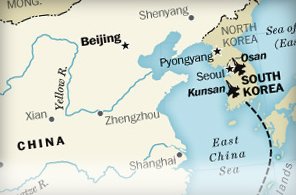
Marshall’s small office in the Pentagon has spent the past two decades planning for a war against an angry, aggressive and heavily armed China.
No one had any idea how the war would start. But the American response, laid out in a concept that one of Marshall’s longtime proteges dubbed “Air-Sea Battle,” was clear.
Stealthy American bombers and submarines would knock out China’s long-range surveillance radar and precision missile systems located deep inside the country. The initial “blinding campaign” would be followed by a larger air and naval assault.
The concept, the details of which are classified, has angered the Chinese military and has been pilloried by some Army and Marine Corps officers as excessively expensive. Some Asia analysts worry that conventional strikes aimed at China could spark a nuclear war.
Jaffe, Greg. "U.S. Model for a Future War Fans Tensions with China and inside Pentagon." Washington Post, 1 August 2012.
-
Belated thanks show NK diplomatic shift
On July 27, while the whole world was focusing on the opening of the 30th Olympic Games in London, North Korea held a big national meeting in Pyongyang, followed by a state banquet and display of fireworks, to mark the 59th anniversary of the signing of the armistice agreement that ended the Korean War (1950-53).
During the celebration, military strongman Choe Ryong-hae, member of the Presidium of the Political Bureau of the Central Committee of the Workers' Party of Korea and director of the Korean People's Army General Political Bureau, made a rare but explicit acknowledgement of China's irreplaceable role during the war, when at least 180,000 Chinese soldiers died fighting the US-led UN forces in a foreign land.
Calling the three-year war "a just war for defending the freedom and sovereignty of the country," Choe told a big gathering "we always remember" that during the early 1950s, "admirable sons and daughters of the Chinese people volunteered to the Korean front."
Meanwhile, the Korean Central News Agency ran a high-profile editorial entitled "Victory in Fatherland Liberation War Is Common Victory of DPRK, China."….
By acknowledging publicly China's role in the Korean War, the North tried to express its gratitude for China's indispensable support in its just-concluded change of leadership as well as to mend unpleasant recent events that damaged bilateral ties, including the North's failure to inform China in advance about its April 2012 satellite launch and the detention in early May of 28 Chinese fishermen by unidentified North Koreans.
No matter what might take place in North Korea, China should spare no effort in adhering to its set strategy of maintaining the peace and stability on the Korean Peninsula, which remains, as ever, in its own best interests.
Chen, Ping. "Belated Thanks Show Nk Diplomatic Shift." Global Times, 2 August 2012.
July
-
South Korea, U.S. to Hold Massive Military Drill
The U.S. and South Korean militaries are slated to stage a yearly large-scale drill next month in accordance with allied efforts to defend against a belligerent North Korea, the Yonhap News Agency reported …
The Ulchi Freedom Guardian exercise is to begin on Aug. 20 and to last through Aug. 31. Approximately 30,000 U.S. troops and roughly 56,000 South Korean military personnel are to take part in the computer-assisted drill, the Combined Forces Command announced.
Military personnel from seven U.N. Command nations -- Australia, Canada, Denmark, France, Norway, New Zealand, and the United Kingdom -- are to observe the exercise….
Pyongyang typically opposes such bilateral military drills, characterizing them as preparations for an invasion….
"South Korea, U.S. To Hold Massive Military Drill." Global Security Newswire, 23 July 2012.
-
Think Tank Urges Placing More U.S. Marines in S.Korea
A U.S. think tank has called for more U.S. Marines to be sent to South Korea to improve the defense and response capabilities of forces here. The Washington-based Center for Strategic and International Studies made the recommendation in a strategy report to Congress on Sunday. ………
The report suggests replacing existing U.S. ground forces here with mechanized infantry units, artillery units and aviation brigades that can be deployed warfare-ready on a rotating basis, or reinforcing the U.S. forces here with National Guard and Reserve troops. It also calls for improving the USFK's weapons and equipment and deploying intercept missiles.
It proposes delaying the transfer of full operational control of the South Korean forces to Seoul slated for December 2015, in case the threat from the North and China mounts ; and improving South Korea's defense capabilities by stationing the U.S. Navy's newest littoral combat ships in Jinhae, South Gyeongsang Province.
"Think Tank Urges Placing More U.S. Marines in S.Korea." Chosun Ilbo, 30 July 2012.
-
Two years on, scientists refuse to cease questioning Cheonan sinking
by Stuart Smallwood
Global Research, July 26, 2012
The sinking of the South Korean anti-submarine corvette Cheonan has been a key reason for the ongoing international isolation of North Korea and contributed significantly to the increased tensions on the Korean peninsula in 2010. But doubters of the official explanation continue to resurface.
The South Korean government-commissioned Joint Investigation Group (JIG) said it was irrefutable that a North Korean submarine sank the South Korean vessel with a torpedo on March 26, 2010, killing 46 navy members. However, the debate has been reignited in South Korea over the last two months because scientists have persistently questioned the JIG report.
In late April this year, Dr. Kim Gwang-sop, former rotational program manager at the National Science Foundation in Washington DC, was invited to do a presentation about the JIG report at a Korean Institute of Chemical Engineers conference. His lecture was cancelled at the last minute because the institute told him it was “too political.”……….
He isn’t the only scientist who has been unable to contribute to the now two-year-old Cheonan debate. Dr. Sam Ahn (Ahn Soo-myong), whose American-based company Ahntech specializes in anti-submarine warfare and had top-secret facility clearance with the US Department of Defense between 1999 and 2008, wrote his own report this year about the scientific impossibility of the JIG’s conclusions. He submitted a section of his report to the Seoul National University Alumni Association for publication but he says it was denied in less than three hours because its contents were too “sensitive.”
Dr. Ahn and Dr. Kim are among a large minority who question the JIG report, other scientists among them. In the summer after the midterm report was released a poll conducted by the South Korean government showed 30 per cent of South Koreans doubted North Korea was involved. More striking, a Russian investigation after the interim report suggested it was unlikely North Korea was responsible. ……….
Tim Beal, a retired professor of New Zealand’s Wellington University and author of two books on the Korean Peninsula, also questions why an anti-submarine corvette would not have been able to detect the North Korean submarine if it did surface to launch the torpedo, particularly when other South Korean and U.S. Navy ships were doing training exercises in the area at the time.
“The Cheonan was no…easy prey for a modern submarine,” Beal wrote in his 2011 book Crisis in Korea. “On the contrary, the Cheonan was a modern ship with other top-class ships, American and South Korean, in the vicinity.”
Russian report says torpedo attack by NK unlikely
Though the official investigation included only allies of the U.S. and South Korea, a Russian group of investigators were allowed access to the findings of the JIG after they had finished their report. ……….
Their investigation concluded that it was unlikely a North Korean torpedo sunk the Cheonan. They were reportedly suspicious of this account already because North Korea could not even make their own torpedoes prior to 1995 and the kind of torpedo capable of making a bubble-jet explosion was in the possession of the only the U.S. and a few other countries. Further, the attack method itself had never been successfully conducted in real naval combat.
As for the “smoking gun” torpedo, the Russian investigation concluded that its level of corrosion suggested it had been in the water for six months or more – far more than the less than three months between the official date of the sinking and when the JIG said they had retrieved the torpedo.
The Russians ultimately speculated that the ship got caught in fish netting (found on one of its propellers) and, while trying to get free, may have dragged up a sea mine causing an explosion.
“This was conjecture, not proof,” Prof. Beal said. “That might have been attainable if the Russians had been brought into the original investigation but no longer. However, what actually caused the sinking is of less consequence than what did not and the Russians were adamant on that.”
The Russian investigators did not actually release their findings to the public. The report was leaked to South Korean newspaper The Hankyoreh and published on May 28 and May 29.
Professor Beal says the Russians likely didn’t release the report because what they discovered would embarrass the South Korean government – something the Russians may have been particularly sensitive about, given their substantial debt owed to South Korea since before the fall of the Soviet Union.
Former Ambassador to South Korea Donald Gregg also wrote in the International Herald Tribune on August 31, 2010, “When I asked a well-placed Russian friend why the report has not been made public, he replied, ‘Because it would do much political damage to [South Korean] President Lee Myung-bak and would embarrass President Obama.’”……….
Smallwood, Stuart. "The Cheonan Incident and the Continued International Isolation of North Korea." Global Research, 26 July 2012.
-
Official Chinese Paper Slams Korea-Japan Military Pact
A military intelligence-sharing pact being pursued by Korea and Japan is a threat to China and must be stopped, an editorial in China's official Global Times said Tuesday.
Headlined "South Korea Must Stick to Role of Balancer," the editorial said, "The military deal, if signed, could turn the U.S.-Japan and U.S.-South Korea alliances into a triangular one." It warned, "Signing the pact would hurt South Korea's relations with China, and this is a geopolitical role South Korea may not be willing to play."
The Global Times said strengthened military ties between Seoul and Tokyo would pose a potential threat to China and urged Beijing to take steps to pressure Korea to scrap the agreement
"Official Chinese Paper Slams Korea-Japan Military Pact." Chosun Ilbo, 4 July 2012.
-
S.Korea must stick to role of ‘balancer’
South Korea has decided to postpone the signing of the General Security of Military Information Agreement with Japan amid strong public opposition to the pact.
The military deal, if signed, could turn the US-Japan and US-South Korea alliances into a triangular one.
The pact nominally targets North Korea, but it actually includes strategic expansion targeting China. Signing the pact would hurt South Korea's relations with China, and this is a geopolitical role South Korea may not be willing to play.
During the Roh Moo-hyun administration, South Korea positioned itself as a balancing force in Northeast Asia. But since Lee Myung-bak stepped into office, politically South Korea has tilted more toward the US and Japan.
The economic scenario is the opposite. Last year, South Korea's trade volume with China surpassed its combined trade volume with the US and Japan.
Strategically, if South Korea leans more toward the US and Japan, it may face an increasingly narrow path ahead….
A military alliance between South Korea and Japan poses a potential threat to China. As a result, China should firmly oppose the move and try to persuade South Korea not to further its military alliance with Japan and the US…..
China and South Korea are close neighbors, and China is also deeply involved in the Peninsula's affairs. This determines that the relationship between Beijing and Seoul has to be friendly. If their strategic partnership is ruined, this will bring a lose-lose situation.
Editorial. "S.Korea Must Stick to Role of ‘Balancer’." Global Times, 3 July 2012.
June
-
The coming conflict
China and the United States seem to be heading toward a course of conflict. These two mega-powers of the world have now become global rivals. Their relations are tense; their interests are in conflict; and they face tougher times ahead. …….
This renewed U.S. commitment to Asia coincides with a recent move by the U.S. Forces in Korea (USFK). Commander Gen. James Thurman said last week that the USFK has requested the Pentagon deploy one aviation battalion of 24 Apache attack choppers, more Patriot missile interceptors and reconnaissance aircraft, all targeting North Korea.
These series of messages and new moves by the U.S. government reflect America’s concern over China's growing influence in Asia. The American focus on Asia in effect has been raising tensions with an ever more powerful China, which has been increasingly assertive in the region.
Traditionally, China has followed a calculated and prudent diplomatic path: "Observe calmly; secure our position; cope with affairs calmly; hide our capacities and bide our time; be good at maintaining a low profile, and never claim leadership." This posture came from the late Deng Xiaoping’s guidance. For the last two decades, China's leaders have generally been quite cautious about doing anything that would arouse anxiety in other Asian countries or, even more importantly, in the United States…….
The Korean Peninsula historically has been caught up in the conflicting interests of its surrounding major powers. Poignant and tragic experiences in the 20th century cannot be allowed to be repeated. …………
Future cooperation with China is gaining greater importance and the Korean government must develop a diplomatic rationale that benefits both Seoul and Beijing.
Shin, Hyun-gook. "The Coming Conflict." Korea Times, 24 June 2012.
-
China takes exception to US-Japan-South Korea military exercises
Beijing officials feel new alliance is being formed to ‘keep China in check’
By Park Min-hee Beijing correspondent
Beijing is raising alarm over joint South Korea-US-Japan naval exercises in south Jeju islands held from June 21-22. China feels the exercises were aimed at checking Chinese military expansion…..
But this is also known to be the first time Seoul has gone on record about joint exercises with the US and Japan….
In response, Chinese People's Liberation Army Navy admiral Yin Zhuo, director of the navy's expert committee on navy information, appeared on the country's state-run CCTV network on June 21 saying the aim of the exercises was to "threaten North Korea and keep China in check."
"If North Korea becomes unstable, or in the off chance there is a clash, then China will be greatly affected in terms of its economic development and personnel," Yin fretted.
He also said that Seoul, Washington, and Tokyo had "taken the first steps toward a 'mini-NATO' in Northeast Asia with their joint military exercises."
Yin noted that South Korea had previously declined to participate in the exercises become of internal political pressures. "President Lee Myung-bak seems to want to take another step before his term ends," he said.
CCTV also ran leading reports on the exercises in which it noted strong opposition in South Korea to the possibility of a military alliance with Japan due to historical grievances stemming from Japan's previous colonial rule of Korea.
Park, Min-hee. "China Takes Exception to Us-Japan-South Korea Military Exercises." Hankyoreh, 23 June 2012.
-
Obama renews sanctions against North Korea
U.S. President Barack Obama has extended sanctions against North Korea as it poses an "unusual and extraordinary threat,” the White House said Monday.
In Los Cabos, Obama and Russian counterpart Vladimir Putin agreed over the unlikelihood of an imminent provocation and called on Pyongyang to adhere to its denuclearization commitments under the six-party talks, a report said.
“We do not believe that any actions will be taken on North Korea’s part that would lead to an escalation of tension on the Korean Peninsula,” the leaders said in a joint statement on the sidelines of the summit, according to RIA Novosti…..
While Washington and Seoul have left the door open for dialogue provided Pyongyang take concrete denuclearization steps, hope is low for an immediate resumption of the six-party talks. Analysts say such a development could expose Obama to criticism during his reelection campaign.
Kim, Young-jin. "Obama Renews Sanctions against North Korea." Korea Times, 19 June 2012.
-
DPRK FM Spokesman Slams U.S. Arms Buildup against DPRK
The commander of the U.S. forces in south Korea on June 12 called for additionally deploying a squadron of attack-helicopters in south Korea and increasing the capacity of missile defense system. He, talking about "threat from north Korea", said that the U.S. military would make its implementation a priority.
The U.S. Defense Department announced on June 13 that the U.S.-Japan-south Korea joint military exercises, first of its kind, would be staged from June 21 in the West and South Seas of Korea and a U.S. nuclear-powered carrier would take part in the exercises.
There took place in Washington on June 14 a military confab between American master and south Korean servants to discuss the issues of stepping up U.S. arms buildup in south Korea and making south Korea an advance base for the implementation of the U.S. strategy for domination over Asia. This is a wanton violation of the Armistice Agreement and an open provocation against the DPRK.
The U.S. is apt to vociferate about the "provocation" by the DPRK, but the facts prove that it is an arch criminal who escalates military tension by pursuing hostile policy towards the DPRK and making military provocations against it one after another.
The aim sought by the U.S. in intentionally aggravating the situation of the Korean Peninsula is to lay hurdles in the general advance of the DPRK for stepping up economic construction and improving people's living standard, and turn south Korea into a servant executing its war policy.
The U.S. arms buildup moves in south Korea is a prelude to a regional war targeting not only the DPRK but also several Northeast Asian countries as they threaten the peace and security of the region, to say nothing of the Korean Peninsula….
2012. DPRK FM Spokesman Slams U.S. Arms Buildup against DPRK. KCNA, 18 June.
-
Korea, US to hold largest-ever drill to mark 62nd anniversary of war
Korean and U.S. armed forces will hold their largest live-fire exercise this week to mark the 62nd anniversary of the start of the Korean War, as tensions continue between the two Koreas, officials said Monday.
The Friday exercise in Pocheon near the tense border with the North will involve more than 2,000 troops, F-15K combat fighter planes, Apache attack helicopters and tanks, said officials at Seoul's defense ministry.
The one-day drill, to be presided over by Prime Minister Kim Hwang-sik, is aimed at displaying a watertight defense posture and war-fighting capabilities, ministry officials said.
An E-737 Airborne Early Warning and Control plane, dubbed "Peace Eye," and T/A-50 light attack aircraft will take part in such a joint drill for the first time, officials said…..
Also later this week, South Korea, the U.S. and Japan will hold two-day trilateral naval maneuvers in waters south of the Korean Peninsula, military officials said.
The three-way exercise, set for Thursday and Friday, will be headed by a U.S. aircraft carrier, the USS George Washington.
On Monday, North Korea termed the upcoming trilateral drills "military provocations," accusing the U.S. of making "arms buildup moves" in South Korea.
"The DPRK (North Korea) is watching with high vigilance the U.S. preparations for war being expanded in a phased manner. It will increase its self-defense capabilities in every way to protect sovereignty and dignity of the country and nation," a spokesman at the North's foreign ministry said in a report carried by its official Korean Central News Agency……
Yonhap. "Korea, Us to Hold Largest-Ever Drill to Mark 62nd Anniversary of War." Korea Times, 2012.
-
China Conducts River-Crossing Drill at N.Korean Border
Chinese troops conducted river-crossing drills on Tuesday afternoon near Dandong on the Apnok River which separates China and North Korea. Around 100 Chinese soldiers partook in the exercise using six or seven small boats and around 10 pontoon bridges measuring 20 to 30 m to move troops and equipment across……
Locals said Chinese troops had conducted several such drills before and that exercises using pontoon bridges usually take place in the summer. The Chinese military exercise appears aimed at preparing for a swift entry into North Korea in the event of an emergency there.
"China Conducts River-Crossing Drill at N.Korean Border." Chosun Ilbo, 14 June 2012.
-
USFK Suggests Keeping Combined Forces Command
U.S. Forces Korea Commander Gen. James Thurman, has proposed that Seoul and Washington keep the Combined Forces Command even after the handover of full operational control of Korean troops in December 2015. Thurman proposed that it should be headed by a Korean officer instead of the USFK chief, as at present…..
Thurman's offer is unprecedented since the U.S. military has never placed itself under another country's command…..
Thurman's offer seems to stem from the recent shift in the Obama administration's foreign policy focus to Asia with the strategic aim to keep China in check….
"USFK Suggests Keeping Combined Forces Command." Chosun Ilbo, 14 June 2012.
-
USFK Wants More Attack Helicopters, Missiles
U.S. Forces Korea Commander Gen. James Thurman said Tuesday he has asked the Pentagon and the Joint Chiefs of Staff to send one more squadron of attack helicopters and bolster the missile defense capabilities of the USFK. [US Forces in Korea]……

James Thurman
"Since Kim Jong-un's rise to the leadership, the threat of a North Korean provocation has increased, and so have Washington's concerns due to the upcoming transfer of wartime operational control" of Korean troops to Seoul in December 2015, said a South Korean military official. "These factors played a role in Thurman's request for the additional Apache squadron, but there is no reason to believe that there are worrisome movements by the North Korean military."….
"USFK Wants More Attack Helicopters, Missiles." Chosun Ilbo, 13 June 2012.
- US Special Forces in DPRK?
Towards the end of May American journalist David Axe reported in the Tokyo-based magazine The Diplomat that a US Special Forces Brigadier General, Neil Tolley, had claimed at a Special Operations Forces Industry (sic) Conference, in Tampa:
U.S. Special Forces have been parachuting into North Korea to spy on Pyongyang’s extensive network of underground military facilities…..
“The entire tunnel infrastructure is hidden from our satellites,” Tolley added. “So we send [Republic of Korea] soldiers and U.S. soldiers to the North to do special reconnaissance.”
The Pentagon objected and The Diplomat pulled the story. Axe however posted his original on his website, along with a personal description of the furore Context of the Korea Special Forces Story which he updates.
The Pentagon denied that it had ever sent troops into the DPRK because that would violate the armistice agreement. The transcript of Tolley’s speech was mysteriously lost and the general himself seems to have moved on to another position. It appears that he said what he was reported as saying, but he claims that he was speaking hypothetically. It may well be that members of the ‘Special Forces industry’ tend to find it difficult to distinguish between fact and fantasy.
It seems that it is unlikely that the US has been sending Special Forces into the DPRK because the chances of them being apprehended are high, and the repercussions would be embarrassing. On the other hand, Special Forces, along with assassination drones, are very fashionable in the United States at the moment, so a little bit of extra-curricular activity is not inconceivable. Moreover, Special Forces, American and South Korean, and other elite assault forces, such as marines, have an important designated role in US plans should a war ‘break out’. The US 31st Marine Expeditionary Unit (MEU) based in Okinawa is poised to seize DPRK nuclear assets to prevent them falling into the hands of terrorists or, it seems, the South Koreans.
-
Seoul asks US to sell cluster bombs
By Lee Tae-hoon
The Defense Security Cooperation Agency (DSCA), an arm of the U.S. Department of Defense, has asked the U.S. Congress to approve Seoul’s request to buy 367 advanced cluster bombs.
“The Defense Security Cooperation Agency notified Congress June 1 of a possible Foreign Military Sale to the Government of the Republic of Korea for 367 CBU-105D/B Wind Corrected Munition Dispenser (WCMD) Sensor Fused Weapons and associated parts, equipment, logistical support and training for an estimated cost of $325 million,” according to a notification issued on the DSCA’s website.
The Korea Times broke the news on Dec. 14, 2011 that the South Korean Air Force plans to acquire CBU-105s this year, one of the most lethal and advanced cluster bombs, citing multiple sources.
Lee, Tae-hoon. "Korea Asks Us to Sell Cluster Bombs." Korea Times, 8 June 2012.
May
-
Lee government making biggest US arms purchases in Korean history
In administration’s last year, huge haul of weapons being bought without public discussion
By Ha Eo-young, staff reporter
The Lee government has become one of the US arms industry’s biggest customers. The government is now pushing ahead with a massive purchase of heavy weaponry that is expected to go through by the end of 2012. It now appears that the purchased items will cost South Korean taxpayers more than twice what was originally anticipated.
Ha, Eo-young. "Lee Government Making Biggest Us Arms Purchases in Korean History." Hankyoreh, 22 May 2012.
-
S.Korea to Build 500-600 More Missiles
South Korea plans to increase the number of ballistic and cruise missiles with a view to incapacitating North Korea's nuclear weapons and long-range missiles in an emergency. The government and military aim to spend some W2.5 trillion (US$1=W1,170) over the next five years to secure 500-600 new cruise and ballistic missiles.
"S.Korea to Build 500-600 More Missiles." Chosun Ilbo, 22 May 2012.
-
Korea plans to 'drastically' beef up missile arsenal against NK
Defense ministry has requested 2.5 trillion won ($2.1 billion) over the next five years to "drastically" beef up its missile arsenal to better cope with missile and nuclear threats from North Korea, a military official said Tuesday.
The budget request was made at a meeting of relevant ministers on fiscal policy, headed by President Lee Myung-bak on April 28, the official said, days after the South's military unveiled a new cruise missile that can hit any target in North Korea.
Yonhap. "Korea Plans to 'Drastically' Beef up Missile Arsenal against Nk." Korea Times, 22 May 2012.
- Kim Jong Un making a mark
New leader Kim Jong Un seems to be getting into stride and with his youthful energy and foreign experience, appears to be infusing a fresh sense of confidence in the country, shaking up the bureaucracy in the process. Admitting the failure of the April satellite launch attempt is an indication of that. It helps that he has the looks and style reminiscent of his charismatic and revered grandfather, Kim Il Sung, as even hostile foreign media ruefully admit. This bodes well for the future if, as I have suggested , the post-Lee Myung-bak president in 2013 returns to a policy of engagement with the North.
Early days yet and, as always, quality reports and analyses are scarce, but here are a few snippets
- Pyongyang was looking a lot more brighter and there was a rather positive and peaceful feel about the place. Kim Jong Un appears to have installed a new vigour and self-awareness into the people.
[Email from New Zealander Roger Shepherd, the photographer/writer whose work on Discovering Korean Identity through Mountains takes him frequently to North Korea]
-
To Sell a New Leader, North Korea Finds a Mirror Is Handy
By Choe Sang-hun
Published: February 1, 2012
SEOUL, South Korea — When Kim Jong-un made his debut as the North Korean heir apparent in September 2010, he looked so much like his grandfather, the closest thing North Koreans had to a god, that South Korean intelligence officials noted that many North Koreans who saw the young man for the first time on television broke down in tears.
A statue of Kim Il-Sung in Pyongyang, left, and Kim Jong-un, right.
Choe, Sang-hyun. "To Sell a New Leader, North Korea Finds a Mirror Is Handy." New York Times, 1 February 2012.
-
N. Korean leader woos support with hands-on style
By Kim Young-jin
North Korean ruler Kim Jong-un is offering something rarely seen from the nation’s top leaders as he rounds up support for his fledgling regime ? a sense of warmth.
From gently clasping a boy’s cheeks while meeting students to linking arms with officials during on-site visits, analysts say the youngest son of late head of state Kim Jong-il has been aiming to project a confident, caring image.
“These gestures aim to gain popularity at a grassroots level,” Park Young-ho, an analyst with the Korea Institute for National Unification said. “He’s showing he wants to be involved and create a sense of closeness.”
New North Korean leader Kim Jongun greets students at the Mangyongdae Revolutionary School in Pyongyang in this undated photo released by the North’s state media on Jan. 25. [2012]
Kim, Young-jin. "N. Korean Leader Woos Support with Hands-on Style." Korea Times, 2 February 2012.
-
Kim Jong Un Tours Mangyongdae Funfair
Pyongyang, May 9 (KCNA) -- Supreme Commander of the Korean People's Army Kim Jong Un, first secretary of the Workers' Party of Korea and first chairman of the National Defence Commission of the Democratic People's Republic of Korea, toured the Mangyongdae Funfair….
In front of the swingboat in the second-phase funfair, he, pointing at the seriously broken pavement in the compound of the funfair, asked officials when the road was last re-paved. It is regretful that the road has not been managed well, he said.
Putting his finger on the faulty arrangement of the bases of Oriental arborvitae and Sabina Chinensis, he said it would be good to have gravel stones planted in various shapes around the trees.
Seeing the weeds grown in between pavement blocks in the compound of the funfair, he, with an irritated look, plucked them up one by one. He said in an excited tone that he has never thought that the funfair is under such a bad state and a proverb that the darkest place is under the candlestick fits the funfair. He scolded officials, saying why such things do not come in their sight and querying could the officials of the funfair work like this, had they had the attitude befitting master, affection for their work sites and conscience to serve the people. Plucking up weeds can be done easily with hands as it is different from updating facilities, he added.
Saying that the amusement facilities have been put into operation with the paint scraped off, he noted that the officials and care-takers of the funfair have below-zero spirit of serving the people. This is not just a business issue but an issue concerning ideological viewpoint, he said in a serious tone.
He dropped in at the fountain pool where he stressed the need to tidy up the place even though it may not go operational for this or that reason.
Officials should draw a serious lesson from the tour of Mangyongdae Funfair, he said, adding that this occasion should be taken to issue a serious warning to the officials so that they can have proper spirit of serving the people.
"Kim Jong Un Tours Mangyongdae Funfair." KCNA, 9 May 2012.
April
-
A new war crisis looms in Korea
What is the U.S. strategy toward the DPRK and Northeast Asia?
The sky is falling!
The U.S. government and media treated the April 13 satellite launch as a virtual act of war by the DPRK. Although no one in the Obama administration disputed that this satellite was for purely non-military purposes, the White House and the U.S. mass media condemned North Korea for using its own launch vehicle or rocket, which they argue was merely a cover for the test of an advanced rocket prototype that could someday be used as a launch platform for a weapon.
The logic of the U.S. argument: any and every effort by the DPRK to do something all other countries desire, which is to possess an indigenous capability to launch its own satellites, must be treated as an existential threat to world peace.
Given that the Pentagon conducts massive mock invasions and mock bombing assaults against the DPRK in regular joint war “games” with South Korea, it is impossible to conceive of the DPRK accepting the notion that its programs are the actual threat to peace on the peninsula.
The tactical orientation of the Obama administration and the Pentagon is to keep North Korea in a resource-draining military and economic vice from which it has neither real options nor escape.
It is impossible to appease or placate the U.S. propaganda machine
The DPRK is attacked for “violating international rules” and its “agreements” with the United States but the opposite is actually true……
Becker, Brian. "A New War Crisis Looms in Korea." ANSWER Coalition, 25 April 2012.
-
S.Korea, U.S. Practice Stabilizing N.Korea in Civil War
[Preparations for invading North Korea if the opportunity arises is a theme of ‘Crisis in Korea’. This article suggests that those plans are still very active]
The annual joint South Korean and U.S. exercises dubbed "Key Resolve" last month for the first time practiced deploying more than 100,000 South Korean troops in North Korea to stabilize the country in case of regime collapse.
The two countries "practiced deploying a large contingent of troops to bring stability in the North in case of civil war in the wake of sudden change there," a government source said on Thursday. "Seoul and Washington practiced preparing for sudden change in the North for the first time during last year's Key Resolve drill, but this was the first time we went on the assumption that South Korean troops would be deployed in the North."
"S.Korea, U.S. Practice Stabilizing N.Korea in Civil War." Chosun Ilbo, 6 April 2012.
February
-
“The Orphan Master’s Son”: No Window
[
The Orphan Master’s Son, a novel by Adam Johnson, has been acclaimed because, as the publisher’s blurb claims, it presents ‘…a riveting portrait of a world heretofore hidden from view: a North Korea rife with hunger, corruption, and casual cruelty but also camaraderie, stolen moments of beauty, and love’. David Ignatius in the Washington Post enthused that ‘Johnson has painted in indelible colors the nightmare of Kim’s North Korea. When English readers want to understand what it was about — how people lived and died inside a cult of personality that committed unspeakable crimes against its citizens — I hope they will turn to this carefully documented story.’
The problem is that Johnson’s North Korea is really a product of uncritically accepted, arguably racist, propaganda and the author apparently knows very little about North Korea, as James Church, the author of the well-regarded Inspector O series gently, too gently, points out.]
By James Church
The range of topics for authors is endless, the techniques of story telling as diverse as the stars in the sky, limited only by what eyes can see—with or without reading glasses—and the public’s brain can comprehend.
All of this applies in spades to Adam Johnson’s new book, The Orphan Master’s Son. Many readers are blown away by its pyrotechnic, shape-shifting, picaresque (choose one or all) approach. It may, indeed, be the best book of the year. The reviews are stellar. All the same, there is a little-noted fly in this ointment, and it is this: For some reason someone decided somewhere along the line to sell the book as a window into North Korea.
That, decidedly, it is not…
If anything, the tragedy comes when literature makes us comfortable with our own stereotypes, when we are eased away instead of being brought face to face with the complexities of the world. Even—or especially—the world of North Korea.
Buy The Orphan Master’s Son, by all means. Read it for fun. Enjoy it or not. Just don’t imagine it opens much of a window into North Korea.
Church, James. "“The Orphan Master’s Son”: No Window." 38 North, 12 February 2012.
-
Obama negligent in embracing Korea's opposition: expert
David Straub, associate director of the Korean Studies Program at Stanford University's Walter H. Shorenstein Asia-Pacific Research Center, said Obama has been "negligent" in trying to broaden support from Korea's opposition for his policy on the Korean Peninsula.
"President Obama, who is very popular among the young people of South Korea, should himself have taken a few hours during his visits to Seoul to appeal to them," he said in a report on Obama's policy on Korea.
Other senior U.S. officials should have made greater efforts to meet opposition leaders, establish personal relationships, and explain American thoughts about the situation on the peninsula, he added.
"The failure to do so may hurt U.S. interests, especially if the Korean opposition wins the legislative and presidential elections this year…
The main variables on the Korean Peninsula in the coming year will be the presidential elections in the U.S. and South Korea and what happens with regards to Iran, Straub said.
Yonhap. "Obama Negligent in Embracing Korea's Opposition: Expert." Korea Times, 13 February 2012.
-
Deployment of U.S. Marines to S.Korea Raises Questions
Seoul and Washington are reportedly in favor of U.S. marines being deployed on South Korea's west coast to prepare for an emergency….
But the U.S. Marine Corps is essentially an attack unit focusing on amphibious operations, and its deployment to South Korea could upset neighboring countries other than North Korea, especially China…..
China, which has on occasion called the Seoul-Washington alliance a "legacy of the past," strongly opposes an additional deployment of U.S. troops in South Korea. It feels that deployment of marines in South Korea could strain Seoul-Beijing relations and cause conflict with Washington as well due to fears that the elite troops would be capable of landing on the Shandong Peninsula.
North Korea could also feel provoked. Another worry is that all foreign and security issues are likely to become politicized as general and presidential elections loom in April and December this year.
A government source said, "Nobody knows what will happen if opposition parties make hay with the deployment of U.S. marines here to claim that the Lee Myung-bak administration is provoking a war."….
"Deployment of U.S. Marines to S.Korea Raises Questions." Chosun Ilbo, 8 February 2012.
-
United States Forces Korea are for the first time carrying out joint exercises with United States Forces Japan and the Japanese Self-Defense Forces
The reason the joint exercise between USFK, USFJ and SDF is drawing attention is its connection to the increasing of so-called “strategic flexibility,” which allows USFK to be deployed in other conflicts in the Asia-Pacific region in times of emergency. The US has been engaged in a project to merge its bases in South Korea and gather them in Pyeongtaek, in order to reorganize the USFK from a mere occupying force to an all-round expedition force…..
This series of measures by the US is being taken with China in mind…..
The current exercise demonstrates that the character of USFK is changing. Accordingly, the importance of the Pyeongtaek base, the closest base to Beijing, will continue to increase.
Lee, Soon-hyuk, and Nam-ku Jung. "USFK to Become More ‘Flexible’." Hankyoreh, 4 February 2012.
-
N. Korea blasts S. Korea-US military drills
North Korea lashed out at South Korea and the United States Saturday, warning that their upcoming joint military exercises would further escalate tension on the Korean Peninsula.
South Korea and the U.S. plan to jointly stage major military maneuvers, called Key Resolve, from Feb. 27 to March 9, with about 200,000 South Korean and 2,100 U.S. troops participating.
Separately, the allies plan to hold the Foal Eagle joint military exercise from March 1 to April 30. The Marines of two countries will also hold a joint landing exercise in March, the largest of its kind in 23 years……
Still, North Korea routinely denounces military drills in the South as rehearsals for a northward invasion.
Yonhap. "N. Korea Blasts S. Korea-US Military Drills." Korea Times, 4 February 2012.
-
North Korea’s wish list falls on deaf ears in Seoul
NDC’s requirements in advance of dialogue unlikely to be met by the South
North Korea’s National Defense Commission, which is considered the country’s highest organ of leadership, on Thursday publicly issued list of nine points ahead of the resumption of inter-Korean dialogue and improved relations. This is the first substantial response from the North Korean government to the suggestion of “high-level talks” that the South Korean government has been making since the beginning of the year. Around half of the questions will be hard for the South Korean government to accept and it is unclear whether the announcement will help improve North-South relations.
First on the NDC’s list was a demand that the South Korean government apologize for not sending official condolences after the December 2011 death of NDC chairman Kim Jong-il. The North also demanded that the South openly declare that it would no longer badmouth the North regarding the sinking of the Cheonan warship and the shelling of Yeonpyeong Island. It asked, too, for a total cessation of the “Key Resolve” joint military exercise due to take place at the end of this month, and the abolition of anti-North Korea laws, such as the National Security Law. It is unlikely that the South Korean government will fall in line with these measures.
Kim, Kyu-won. "North Korea’s Wish List Falls on Deaf Ears in Seoul." Hankyoreh, 3 February 2012.
January
The sudden death of North Korea’s leader Kim Jong-il could lead to a major crisis and even military conflict between the United States and China.
The succession of power to Kim Jong-un, Kim Jong-il’s youngest son, seems to be proceeding smoothly so far, but it remains uncertain whether regime stability can be preserved. If Kim Jong-un’s rule is challenged in the coming months or years, the regime could collapse, causing civil conflict, refugee flows, or “loose nukes.” That scenario would likely result in U.S. and South Korean forces heading across the 38th parallel to stabilize the country, provide humanitarian assistance, and identify and secure the nuclear and other weapons of mass destruction sites. China might then dispatch the People’s Liberation Army into North Korea, perhaps in response to a request from a military faction that invokes the 1961 Sino–North Korea Treaty of Friendship, Cooperation, and Mutual Assistance.
Glaser, Bonnie. "China in 2012." CSIS Critical Questions, 9 January 2012.
Both the greatest threat and opportunity over the next year is what follows the sudden death of Kim Jong-il in North Korea
The power succession to his not yet 30-year-old son could lead to more belligerent provocations against the United States and its allies in order to cement his leadership position. Or the power succession could fail, leaving us with dire concerns about who then in North Korea has control of its nuclear arsenal. At the same time, the death of a dictator who starved his people while accumulating nuclear arms could open opportunities for new diplomacy with the West or even Chinese-style reform in that dark kingdom. Which way North Korea goes is unknown and requires serious study.
Cha, Victor. "Korea in 2012." CSIS Critical Questions, 9 January 2012.
A Korean Spring?
As 2011 came to a close, the death of North Korean leader Kim Jong Il took the world by surprise (including the CIA which, like the rest of us, only learned of his passing 48 hours later). Given the dearth of understanding about North Korea in the West, the media could only speculate about the future of the new regime in Pyongyang. The usual pundits also took the opportunity to renew their calls for regime change. After all, 2011 was the year when the masses rose up to overthrow repressive regimes; could the same fate be in store for North Korea?
If anything has become clear in the weeks following Kim Jong Il’s passing, it is that regime collapse is not in the cards for North Korea….
What happens in North Korea, however, is also clearly influenced by what happens in Seoul, and the winds of change are blowing strong south of the Demilitarized Zone where grassroots movements are challenging the country’s retrograde neo-Cold War leadership. After four long years under President Lee Myung Bak’s repressive and hard-line policies, 2011 marked the revival of democracy in South Korea thanks to three particularly inspiring developments for peace, economic justice, and anti-corruption
A third development in South Korea that has become legendary for raising tough issues of corruption by President Lee and other political leaders is the hugely popular weekly online talk show that launched in April. Named after the nickname given to President Lee by his most vocal critics, “NaneunGgomsuda” ("I am a petty-minded creep”)covers corruption within South Korean politics and the dominance of the conservative, pro-business, and pro-government media.
The changes occurring in South Korea may not only usher in a more progressive regime in 2012 and greater social justice; it will undoubtedly influence the way that Pyongyang chooses to engage with Seoul. It took both North and South Korean leaders to make the sunshine policy possible, though the South Korean leaders got most of the credit…..
The popular uprisings in the south will no doubt influence prospects for reconciliation, peace, and the reunification of Korea. These changes on the Korean peninsula present a unique opportunity for the Obama administration to take a constructive approach on Korea for a change, instead of blindly following an unpopular South Korean president whose time is up.
Ahn, Christine. "A Korean Spring?" Foreign Policy in Focus, 4 January 2012.
2011
December
-
Kim Jong Il ….was beloved by the people, as we see with the outpouring of grief upon his death.
During the second Kim Jong Il era, decision making was largely collective. Although the decision makers may not have been collectively recognized, the center of the party was the worker's party. Kim Jong Il became synonymous with the center of the party, which made decisions. In North Korea, there are 12-13 people who make decisions, and all these individuals are intact. Kim Jong Un's job is to succeed these policies, so things will remain the same, not just in Pyongyang, but also in foreign policy as well….
A lot of people speculate that there might be a military junta since Kim Jong Il's passing. A military coup is unthinkable for many reasons, as is the prospect of an Arab Spring-type of uprising against the North Korean leadership….
Frankly, what is driving U.S. policy towards North Korea are the interests of the military industrial complex. They want North Korea to be militarily strong, stronger than it is. North Korea is not a threat to the United States, but they perpetuate the myth that it is. Secondly, these interests like to perpetuate the myth that North Korea is evil and has the intention to strike the United States, which is just what they need to justify the costly missile defense system. ….
As we know, South Korea is anything but sovereign, especially militarily and in making foreign policy decisions….
I hope that Washington will no longer be a hostage of Seoul, which with the recent election of Seoul, will likely lead to something else. I am very hopeful about that because the conservative base is being disintegrated.
Park, Han S., and Christine Ahn (interviewer). "The Legacy of General Kim Jong Il: An Interview with Professor Han S. Park." Korea Policy Institute, 28 December 2012.
-
I remember my first close encounter with Kim Jong Il …….
…in July 2000 in Pyongyang, when he briskly walked into the room in Paekhwawon Guest House, where Russian President Putin and his entourage, of which I was honored to be a part, was waiting for him. He energetically shook hands with everyone without looking them in the eyes. My first real-life impression of this man whom I had seen in photos and videos (as well as from a distance) so many times was that he was more than met the eye. Having encountered several Koreans from all walks of life both in the North and South and abroad during my decades as a Koreanologist, I was impressed how this particular Korean was different: he emanated charisma and intellect, looked free and relaxed. His speech was fast and witty, he seemed to draw on enormous resources of intellect and had a remarkable memory on almost any subject (one exclusion might be modern economics, in which he, it seemed, was not so very interested, regarding it just as a tool for rich Westerners to extract profits from their fellow compatriots and poor countries).
This first impression of Kim as a really remarkable personality only deepened during subsequent meetings lasting for many hours, both in Russia (especially on one trip when we travelled on Kim Jong Il’s train for almost two weeks across Russia) and in Pyongyang, in the company of many Russian dignitaries, sometimes in a quite informal atmosphere. Kim would freely talk on subjects as varied as relations with the United States, the situation in South Korea (which he knew well, much better than we did as Russian diplomats), international politics as well as Russian cinema and folk music. He was inquisitive, open to argument and never forgot what was said. He even remembered details about Russian diplomats and dignitaries involved in North Korean affairs from the time his father was in power and had a judgment on each one. He highly valued sincerity and wholeheartedness. The North Korean leader’s aide (known worldwide as Kim Ok) would prompt him with some details if he would ask, and Kim Jong Il would never hesitate to ask his subordinates about certain specific issues (like economic or military ones); he was not trying to show his “superhuman abilities.” It is true that Kim was fond of wine, good food and song, but for us Russians, not bound by Western political correctness, that was not something appalling. He was quick enough to make decisions on the spot, and usually these decisions proved later on to be right.
Toloraya, Georgy. "Kim Jong Il: The Lessons of Life and Death." 38 North, 28 December 2011.
-
Kim Jong-il's death could provide an opportunity to improve inter-Korean relations.
"Kim Jong-un, who will lead the North in the future, and some new-generation North Koreans have studied abroad and are familiar with computers and other electronic gadgets," he said. "This could lay a promising groundwork for change in the North."…
The South Korean government's decision not to send an official delegation to Kim Jong-il's funeral, he said, was wrong. "No matter how hostile your neighbor was when he was alive, it's a kind of Korean tradition that anything is forgiven and accepted at funerals," he said. "A condolence visit by the South Korean government could provide an opportunity for thawing inter-Korean relations."
American Dr. John Linton, the director of International Health Care Center at Yonsei University's Severance Hospital in Seoul, has visited North Korea 23 times since 1997
"American Doctor Recounts Changes in N.Korea." Chosun Ilbo, 27 December 2011.
-
Post-Kim Jong Il DPRK
Predictions that the DPRK will shortly plunge into chaos and that a tide of infighting will sweep over its leadership are completely groundless. Any serious watcher is fully aware of the country's robust political stability, with nothing like an organized opposition or public protests of considerable proportions in sight. ….
It became known that over the past several days US Secretary of State H. Clinton engaged in intense consultations with representatives of the countries neighboring North Korea. In particular, she had several phone conversations with the foreign ministers of Russia and China. The contents of the talks remained undisclosed, but hypothetically Washington could be trying to bounce at least some kind of unarticulated consent to regime change in the DPRK out its partners. If this is the case, the probability that the endeavors produced any results is minimal. To stress the importance of its ties with the DPRK, Beijing took an unprecedented diplomatic step when China's leader Hu Jintao and eight other top Chinese officials visited the N. Korean embassy to deliver condolences.
Vorontsov, Alexander. "Post-Kim Jong Il Dprk." Strategic Culture Foundation, 25 December 2011.
-
Kim Jong-il’s Death is a Danger for North Korea, not its Neighbors
There are a few facts to keep in mind to understand what’s going on in the wake of the death this week of North Korean leader Kim Jong-il.
#1. US foreign policy vis-a-vis North Korea has always sought to force the latter’s collapse to pave the way for its absorption into the US-dominated South— and did so well before Pyongyang began to work on nuclear weapons. US hostility toward North Korea has never been about nuclear weapons. On the contrary, North Korea’s nuclear weapons are a consequence of US hostility. US hostility, now in its seventh decade, is about what it has always been about: putting an end to what Washington mistakenly calls North Korea’s Marxist-Leninist system (Marxism-Leninism has been replaced by Juche ideology—a home-grown doctrine of self-reliance), its non-market system, and its self-directed economic development. None of these offer much latitude for US profit-making at North Korea’s expense, and hence are singled out for demolition.
Gowans, Stephen. "Kim Jong-Il’s Death Is a Danger for North Korea, Not Its Neighbors " What's Left, 20 December 2011.
-
China’s Newest Province?
NORTH KOREA as we know it is over. Whether it comes apart in the next few weeks or over several months, the regime will not be able to hold together after the untimely death of its leader, Kim Jong-il. How America responds — and, perhaps even more important, how America responds to how China responds — will determine whether the region moves toward greater stability or falls into conflict
Cha, Victor. "China’s Newest Province?" New York Times, 19 December 2011.
October
American ground forces will be essential for the most likely East Asia contingency, that arising from a Democratic People’s Republic of Korea (DPRK) collapse, but less so for the others.
North Korea A North Korean collapse could emanate from a failed economy, a contested power transition after the death of Kim Jong-il, or defeat in a war with the South. In any such scenario, the situation in North Korea would likely be chaotic and confused. Hundreds of thousands, perhaps millions, of civilians would migrate toward North Korea’s borders in search of food and safety from clashes between rival armed groups. …
China meanwhile would view the insertion of U.S. and Republic of Korea (ROK) forces north of the DMZ with concern, and might move its own forces in, if it had not already begun to do so, both to contain the disorder and preempt a ROK/U.S. takeover of the entire country. While the ROK would provide sizable forces and capabilities for these missions, they would be inadequate to deal with the scope and complexity of a complete DPRK collapse. Substantial and extended commitments of U.S. ground forces would be required …..
The likelihood of confrontations, accidental or otherwise, between U.S. and Chinese forces is high, with significant potential for escalation. Beyond the pressures to intervene and deal with the immediate consequences of a failed DPRK, the United States will be forced to confront the thorny issue of the desired end-state: unification (the preferred outcome of our ally, the ROK) or the continued division of Korea (China’s strong preference)….
Other than Korea, the contingencies do not call for sizable U.S. ground forces. U.S. involvement in large-scale land warfare anywhere in East Asia other than Korea is especially improbable. The Korean collapse scenario, judged the most likely, could well involve some competition but probably not open conflict with China, but would in either case call for a significant ground force contribution….
As the defense of Taiwan is already becoming problematic for U.S. forces (e.g., carriers and nearby air bases), so will U.S. operational options in the event of a confrontation with China over North Korea’s collapse and a crisis in Southeast Asia. Over time, the United States will feel the need to rely increasingly on its more distant and less vulnerable capabilities….
The United States should also continue to explore cooperative solutions to
some of the above-cited sources of conflict. For instance, the collapse of North Korea could
become an opportunity for U.S.-Chinese collaboration.
The economic consequences of a Sino-American conflict could be historically unparalleled,
even if both sides avoid economic warfare. This is a powerful mutual deterrent, one marginally
in the U.S. favor at present.
Dobbins, James, David C. Gompert, David A. Shlapak, and Andrew Scobell. "Conflict with China: Prospects, Consequences, and Strategies for Deterrence." Rand Corporation, 10 October 2011.
China 'Unlikely to Intervene in Korea'
China will not support North Korea militarily in case of a conflict between North and South, according to a Chinese academic. Prof. Chu Shulong (55) of Tsinghua University was speaking at a seminar on Korea-China security strategy at the Seoul Press Center on Monday.
"I believe China will call for a diplomatic solution even if the North is attacked by South Korea or the U.S.," Chu said. "Most Chinese don't think a reunited Korea would stand against China, even if the U.S. keeps stationing troops or bases on the peninsula. China won't mind Korean reunification, even if it is led by South Korea."
Chu said the Beijing-Pyongyang relationship is friendly and cooperative on the surface, but the truth is very different. "Chinese leaders, bureaucrats and citizens neither like nor support many North Korean policies and actions it has taken at home and abroad, including its development of missiles and nuclear weapons and its attacks on South Korea last year," he added.
But he also cast doubt on the "strategic cooperative partnership" South Korea and China have declared. The two "don't have the same strategic concerns and understanding, even though they currently share some basic strategic interests."
With a doctorate from George Washington University, Chu is an influential expert on the U.S. and Sino-U.S. relations. He has previously called on Beijing to distance itself from the North
Chosun Ilbo, Seoul, 18 October 2011
The Collapse of North Korea: Military Missions and Requirements
In North Korea, the upcoming leadership transition in the Kim Jong-il regime will be a precarious time for the Kim family's hold on power. A collapse of the North Korean government could have several dangerous implications for East Asia, including “loose nukes,” a humanitarian disaster, a regional refugee crisis, and potential escalation to war between China and the United States. To respond to a collapse and these problems, neighboring countries may perform several military missions to stabilize North Korea. These include the location and securing of North Korean weapons of mass destruction, stability operations, border control, conventional disarmament, and combat/deterrence operations. Assuming that collapse occurs in a relatively benign manner, military missions to stabilize North Korea could require 260,000 to 400,000 troops. If collapse occurs after a war on the peninsula, or if it sparks civil war in North Korea, the number of missions—and their requirements—would grow. Because of the size and complexity of these missions, and because of the perils associated with mismanaging them, advance and combined planning is essential. Combined planning should include those actors (e.g., China, South Korea, and the United States) that could otherwise take destabilizing action to protect their own interests.
Bennett, Bruce W., and Jennifer Lind. "The Collapse of North Korea: Military Missions and Requirements." International Security 36, no. 2 (Fall 2011).
See also