Imperial nostalgia: Britain in the
South China Sea
In a pub in rural New
Zealand two men, one old and one young, come together to discuss world affairs,
to have a drink and swap insults. They start by discussing an article, or a
batch of articles, that one of them, usually the younger, has selected. During
their conversation they also access other articles, the younger man via his
smart phone and the older one via his venerable laptop, which also holds his
database of geopolitical literature, and if rumour is to be believed, more
besides. In addition there is a ghostly editor who also inserts references,
often making snide remarks about the old man and correcting his lapses of
memory.
Today’s articles are:
·
"Commentary: London needs to tread
cautiously on South China Sea," Xinhua, 2 December
2016.http://news.xinhuanet.com/english/2016-12/02/c_135876942.htm;
·
"Stop meddling in South China Sea dispute,
Chinese diplomat demands," Xinhua, 5 May
2016.http://news.xinhuanet.com/english/2016-05/05/c_135334841.htm;
·
David Brunnstrom, "British fighters to overfly South China
Sea; carriers in Pacific after 2020: envoy," Reuters, 2 December
2016.http://www.reuters.com/article/us-britain-southchinasea-fighters-idUSKBN13R00D;
·
Matt Hunter, "Britain to sail its new flagship aircraft carrier with a squadron of
Typhoons through the disputed South China Sea in show of strength aimed at
China," Daily Mail, 5 December
2016.http://www.dailymail.co.uk/news/article-4000826/Britain-sail-new-flagship-aircraft-carrier-squadron-Typhoons-disputed-South-China-Sea-strength-aimed-China.html;
·
Tim Steinecke, "Britain and the South China Sea Conflict:
End to Ambiguity?," Diplomat, 11 July
2016.http://thediplomat.com/2016/07/britain-and-the-south-china-sea-conflict-end-to-ambiguity/

“Hi Sage, how you going? Ready for a top-up?”
“Hello Marty. Wish you wouldn’t. This Sage business”
“Well if you’re going to have a scruffy grey beard and look like Don Quixote you’re asking for it”
“I don’t think Don Quixote was noted for his wisdom, Marty”, sighed the Sage, ‘rather the reverse. Anyway, on to more important matters than your unfamiliarity with the works of Cervantes. I’m well, and I am ready for a top-up. Glass of the Pencarrow Sav please.[1] Put it on the tab, and don’t embarrass me with your choice of drinks.
Marty came back to the table with the drinks, sat down and put his smartphone on the table.
“What’s in your magic machine today, Marty?”
“Well, I’m a bit bemused by these articles about the British preserving freedom of navigation in the South China Sea.[2] It’s a long way from home; what’s up?”
“Well, I think you’ll find it really has more to do with the Atlantic Ocean than the South China Sea, and really about the stopping of transit, rather than the protection of it”
‘That’s a bit gnomic – please explain”
“OK, let me have a sip of wine first and then let’s see if we can tease things out. A bit of history, a bit of geography, and the usual lies and deceptions.
The South China Sea is certainly a long way from home but the British did claim to have an empire on which the sun never set.”
‘It’s certainly set now!”
‘Yes, but nostalgia is a powerful force. Probably a factor in Blair’s little adventures in the Middle East and I think we can see its effect in many aspects of contemporary British policy, and this business in the South China Sea is another example”
“Who was the bloke who said that the British had lost an empire but hadn’t found a role?”
“US Secretary of State in the 1950s I think. Perhaps Acheson. [3] The Americans were always rather condescending about the Brits; still are. Bit like a young man taking over the estate from his doddering old father.”
“But the Americans have taken over the estate haven’t they, and expanded it greatly, haven’t they?”
“Indeed, and the old man still likes to lend a hand just to show that he hasn’t lost it entirely. But in doing so he often does make it obvious that he’s past it. The Americans I think were particularly scathing about the British in Afghanistan”[4]
“But the Brits are lending a hand in the South China Sea?”
“Exactly, symbolically at least. And of course there is the historical connection. The man who termed the phrase about the sun never setting on the British empire was Lord Macartney and it was he who was sent by George III to China at the end of the 18th century to persuade them to open the doors to trade and buy all those good things coming out of the industrial revolution.”
“How did he get on?”
“Not well. A complicated story which we can come back to sometime but basically the Chinese emperor told him to piss off because the Brits weren’t selling anything they wanted”
“That was a bit short sighted.”
“Yes, and no. But the Brits did find something the Chinese would buy, despite the emperor’s best efforts, and that was agricultural products.”
“Not the fruits of the industrial revolution then?”
“No, and not from Britain. From India – the British raj -and the products were cotton, and opium.”
“Ah, hence the Opium Wars?”
“Yep, so there is a historical link to the imposition of free trade and I guess freedom of navigation. But times have moved on.”
“The articles talk about preserving the freedom of navigation through the South China Sea. Are the Chinese threatening to disrupt it?”
“Well, there are a few interesting factors at work here Marty. Firstly do you think the British have a strong direct interest in safeguarding shipping though the South China Sea? Can you pick up a map of international trade routes on your smartphone?
“OK, what about this one from the International Maritime Organization?”[5]

“Sounds official. Yes, look’s good. Obviously it’s not detailed but I think it’s clear that not a huge percentage of British trade goes through the South China Sea, and , what is more important, not much of that trade through the South China Sea is connected with Britain.”
“Ah, so that’s what you meant when you said it was to do more with the Atlantic Ocean rather than the South China Sea.”
“Exactly. The British are getting involved primarily to curry favour with the Americans.”
“The Special Relationship?”
“Another subject which warrants a bottle of wine sometime”
“Not just wine Sage, some real drinks as well”
“Talking figuratively Marty.
“But Sage, surely the same thing applies to the US? Looking at the map we can see a lot of trade between the US and Europe, across the Atlantic. And then trade across the Pacific to Japan and China, but that wouldn’t go through the South China Sea, would it?”
“You’re right. The Americans have claimed that nearly a quarter of the trade through the sea is US, but that doesn’t seem plausible.[6] “
“What about oil from the Gulf to the West Coast of the US? Wouldn’t that go through the South China Sea?”
“Yes. Let’s find a route map and see what it suggests”
Marty has a quick search and exclaims, ”What about this one?”
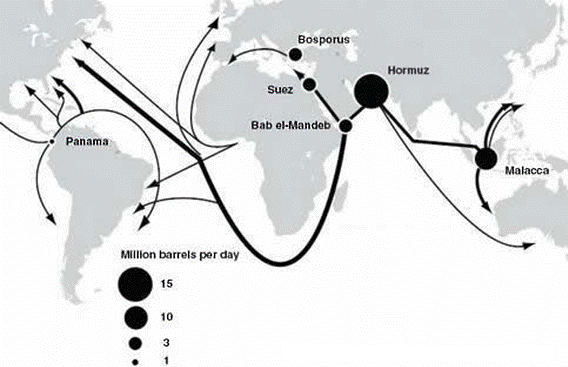
Source: U.S. Government Accountability Office
Note: Circles represent millions of barrels per day transported through
each chokepoint. Arrows represent common petroleum maritime routes.
"Maritime chokepoints critical to
petroleum markets." US Energy Information Administration, 2 March 2011.http://www.eia.gov/todayinenergy/detail.php?id=330
“Yes, seems to cover it. And straight from the US government, so we can’t be accused of falling for Chinese propaganda!”
“Looks like most of the oil from the Gulf to the US goes westward through the Suez canal or around the Cape. The eastward flow seems primarily destined for Japan and China.”
“Indeed, if the flow of oil across the Pacific to the West Coast were important I presume the map would include it.”
“OK, so neither Britain nor the US actually have much of their trade through the South China Sea. So why the fuss?”
“Well it might be that they are concerned about their ‘allies’, principally Japan and South Korea. However transit through the South China Sea is not essential for them and the costs of skirting it are not prohibitive. Peter Lee, who does the China Matters website points out that the one nation which really depends on freedom of navigation through the South China Sea is in fact China.”[7]
“China? But the US is surely not concerned about preserving freedom of navigation for China?”
“No, of course not. The South China Sea is one of the places – a chokepoint – where Chinese energy imports is vulnerable. Look at this quote on my laptop from Peter Apps, commenting on a recent RAND report analysing the outcome of a war between the US and China.[8]
Washington
and Beijing are each other’s most significant trading partners. The report
estimates that 90 percent of that bilateral trade would cease if the two were
in direct military confrontation for a year. That would hurt both sides, but
the United States could likely continue trade with much of the rest of the
world while almost all imports and exports to China would have to pass by
sea through a war zone.
Perhaps most importantly, China might find itself cut off from vital external energy sources while Washington’s energy supply chain would be far less affected.[9]
“Wow. So the South China Sea would be one of the places where the US could block Chinese energy imports?
“Yes, not merely closer to home but also where the US has traditionally had bases that sit aside the South China Sea.”
“And that, I guess is the Philippines and explains why the US is so interested to retain them.”
“Duterte’s election puts them in jeopardy – another thing to be discussed sometime. As are China’s moves to develop more secure access to Middle East oil across Eurasia But the interdiction of trade is not the only reason the US wants a military presence in that area.
“What’s the other one?”
“China’s main submarine base is reportedly on Hainan and so to get SLBMs through to the deep waters of the Pacific they have to transverse the shallow waters of the South China Sea.”[10]
“SLBMs?”
“Sorry, Submarine launched ballistic missiles. Like the British Tridents.
“So now I see why you said it was really about the stopping of transit. So the articles we started off with were completely wrong.”
“Well, as is so often the case the media gives a portrayal which is at variance with the reality – often diametrically opposite. Anyway, enough of that for the moment. Let’s have another drink and discuss your sex life.”
“Well Sage I did meet a beaut girl last week who’s new to town; from Scandinavia I think, and she built like …….”
“OK Marty, I get your gestures. So it’s this week for girls is it?”
“Sage”, said Marty rising to go to the bar, “most weeks it’s for girls.”
And the Sage sat pondering the ambiguity of that remark.
Apps, Peter. "Commentary: Here’s how a U.S.-China war could play
out." Reuters, 9 August 2016.http://www.reuters.com/article/us-commentary-china-apps-idUSKCN10I0WB
Brunnstrom, David
"British fighters to overfly South China Sea; carriers in Pacific after
2020: envoy." Reuters, 2 December
2016.http://www.reuters.com/article/us-britain-southchinasea-fighters-idUSKBN13R00D
Chan, Minnie.
"South China Sea air strips’ main role is ‘to defend Hainan nuclear
submarine base’." South China
Morning Post, 25 July 2016.http://www.scmp.com/news/china/diplomacy-defence/article/1993754/south-china-sea-air-strips-main-role-defend-hainan
"Commentary: London
needs to tread cautiously on South China Sea." Xinhua, 2 December 2016.http://news.xinhuanet.com/english/2016-12/02/c_135876942.htm
Duchâtel, Mathieu, and
Eugenia Kazakova. "Tensions in the South China Sea: the nuclear
dimension." SIPRI Newsletter,
July-August 2015.http://www.sipri.org/media/newsletter/essay/july-aug-15-south-china-sea
Glaser, Bonnie S. .
"Armed Clash in the South China Sea " Council on Foreign Relations, April 2015.http://www.cfr.org/asia-and-pacific/armed-clash-south-china-sea/p27883
Gompert, David C. ,
Astrid Stuth Cevallos, and Cristina L. Garafola. "War with China: Thinking
through the Unthinkable." RAND,
28 July 2016.http://www.rand.org/content/dam/rand/pubs/research_reports/RR1100/RR1140/RAND_RR1140.pdf
Hunter, Matt
"Britain to sail its new flagship aircraft carrier with a squadron of
Typhoons through the disputed South China Sea in show of strength aimed at
China." Daily Mail, 5 December
2016.http://www.dailymail.co.uk/news/article-4000826/Britain-sail-new-flagship-aircraft-carrier-squadron-Typhoons-disputed-South-China-Sea-strength-aimed-China.html
Lee, Peter.
"Beijing’s South China Sea expansion: The salami slices back!" Asia Times Online, 19 May 2015.http://www.atimes.com/article/beijings-south-china-sea-expansion-the-salami-slices-back//
"Maritime
chokepoints critical to petroleum markets." US Energy Information Administration, 2 March 2011.http://www.eia.gov/todayinenergy/detail.php?id=330
Meek, James "Worse
than a Defeat." London Review of
Books, 18 December 2014.http://www.lrb.co.uk/v36/n24/james-meek/worse-than-a-defeat
"The Role and
Importance of International Shipping ". International Maritime Organization, 2016.http://www.imo.org/en/KnowledgeCentre/ShipsAndShippingFactsAndFigures/TheRoleandImportanceofInternationalShipping/Pages/TheRoleAndImportanceOfInternationalShipping.aspx
Steinecke, Tim
"Britain and the South China Sea Conflict: End to Ambiguity?" Diplomat, 11 July 2016.http://thediplomat.com/2016/07/britain-and-the-south-china-sea-conflict-end-to-ambiguity/
"Stop
meddling in South China Sea dispute, Chinese diplomat demands." Xinhua, 5 May 2016.http://news.xinhuanet.com/english/2016-05/05/c_135334841.htm